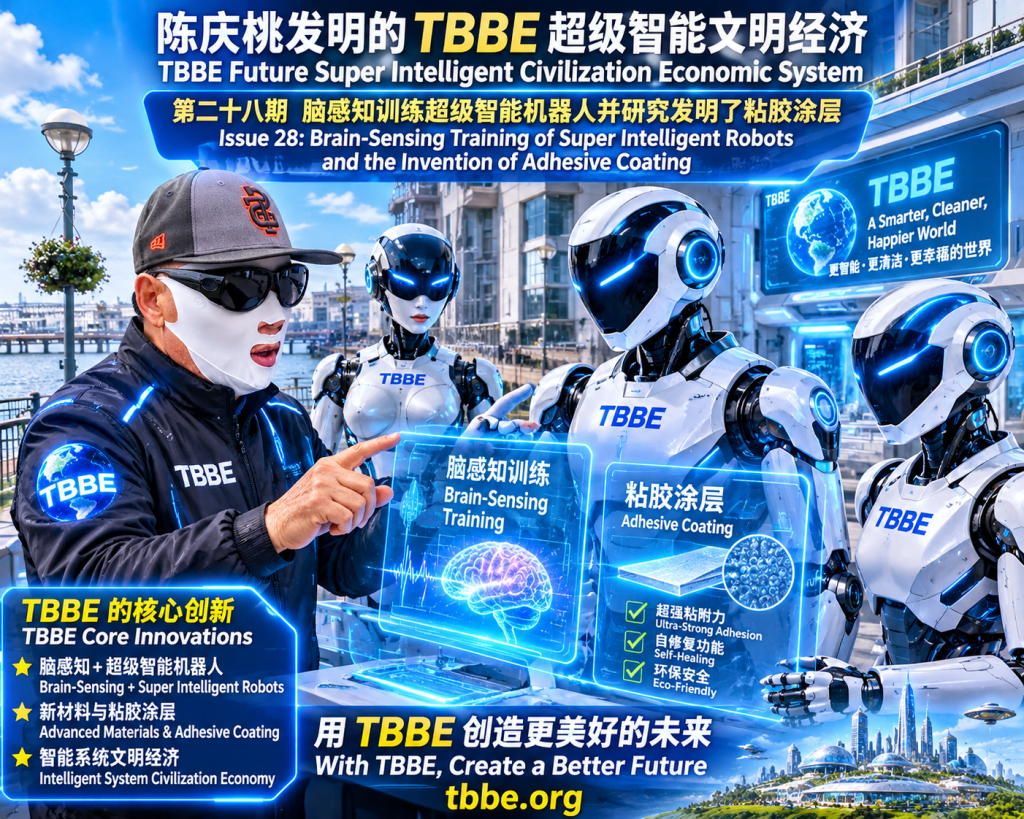
一、引言:开启超级智能机器人新时代
随着人工智能、新材料、智能制造和信息技术的不断发展,人类正在进入一个全新的超级智能文明时代。
陈庆桃发明的TBBE超级智能文明经济理论,致力于研究未来智能系统如何改变传统生产方式、经济结构和人类社会生活。
本期重点研究两个重要方向:
- 脑感知技术与超级智能机器人训练。
- 新型粘胶涂层材料的研究与发明。
通过这两个方向的结合,探索机器人从传统程序控制向智能感知、智能学习、智能训练和自主协同发展的新道路。
二、脑感知训练:让超级智能机器人理解人的意图
传统机器人主要依靠预先编写的程序、传感器和外部控制系统完成任务。
未来的超级智能机器人,需要进一步发展人的动作感知与脑感知相结合的智能训练体系。
脑感知是通过非侵入式脑电等感知技术,结合人工智能算法,对人的部分脑部活动信号进行分析,识别经过训练的特定意图。
通过人类示范、机器学习和反复训练,使机器人逐步理解特定指令,并将识别结果转化为相应的动作任务。
这一研究方向的核心是:
- 人的动作感知。
- 人的脑感知。
- 人工智能识别与分析。
- 机器人动作训练。
- 多机器人协同学习。
最终探索建立人与超级智能机器人之间更加自然、高效的智能交互体系。
三、三个超级智能机器人的联合训练系统
本期提出三个超级智能机器人协同训练的研究构想。
三个机器人不再只是独立完成简单任务,而是通过统一的智能系统进行信息交流、任务分配和协同训练。
第一台机器人:负责感知与学习。
通过人的动作示范、环境信息和训练数据,学习识别不同任务。
第二台机器人:负责智能执行。
根据训练系统传递的任务信息,完成相应的操作,并反馈执行结果。
第三台机器人:负责协同与辅助训练。
参与信息交流、任务协调和训练效果评估。
三个机器人通过统一的智能系统形成一个整体,实现相互配合、持续学习和系统升级。
这将成为未来超级智能机器人自主制造与智能训练体系的重要研究方向。
四、新型粘胶涂层材料的研究与发明
除了脑感知和机器人训练,新材料也是未来超级智能制造文明的重要基础。
本期提出研究新型粘胶涂层材料,探索其在超级智能机器人制造中的应用价值。
研究方向包括:
- 涂层与不同材料表面的结合性能。
- 粘附能力与耐久性能。
- 柔韧性及环境适应能力。
- 材料表面保护与防护性能。
- 在机器人零部件和智能制造中的应用。
通过材料配方、表面处理和实验测试,逐步研究不同应用环境下的性能表现。
未来如果能够形成具有稳定性能和实际应用价值的新型粘胶涂层技术,将有机会应用于机器人制造、智能设备、新材料工业和高端制造领域。
五、脑感知与新材料的结合
脑感知解决的是机器人如何理解人的意图。
新型粘胶涂层解决的是机器人制造过程中材料连接和表面应用方面的问题。
两个研究方向虽然不同,但都属于超级智能机器人产业体系的重要组成部分。
将智能感知、人工智能、机器人训练、新材料和自动化制造进行系统整合,可以探索建立更加完整的超级智能制造体系。
六、TBBE未来超级智能文明经济的发展意义
TBBE认为,未来经济发展的重要动力,将逐步从传统的人力劳动和单一生产设备,向人工智能、超级机器人、智能制造、新材料和全球智能系统协同发展。
超级智能机器人不仅是未来制造业的重要工具,也是未来社会服务、物流运输、智能城市和高端工业的重要组成部分。
通过持续研究和技术创新,可以探索提高生产效率、降低重复劳动、创造新的产业价值,并推动未来社会向更加智能、绿色和高效的方向发展。
七、未来展望
陈庆桃发明的TBBE超级智能文明经济,将继续围绕脑感知、人的动作感知、超级智能机器人、新型材料、智能制造和系统经济开展研究。
第二十八期提出的三个超级智能机器人联合训练构想,以及新型粘胶涂层材料研究,是未来智能机器人制造与升级体系中的两个重要探索方向。
TBBE希望通过持续研究、技术实验和国际合作,推动人类从传统工业文明向超级智能文明迈进。
TBBE:以超级智能创造未来,以科技创新创造社会价值。
Issue 28: Brain-Sensing Training for Super Intelligent Robots and Research on New Adhesive Coating Materials
1. Introduction: Entering a New Era of Super Intelligent Robotics
With the continuous development of artificial intelligence, advanced materials, intelligent manufacturing, and information technology, humanity is moving toward a new era of super intelligent civilization.
The TBBE Future Super Intelligent Civilization Economic Theory, invented by Chen Qingtao, explores how future intelligent systems can transform traditional production methods, economic structures, and human society.
This issue focuses on two important research directions:
- Brain-sensing technology and super intelligent robot training.
- Research and invention of new adhesive coating materials.
Combining these two directions opens new possibilities for robots to develop from traditional programmed machines into intelligent systems capable of perception, learning, training, and coordinated operation.
2. Brain-Sensing Training: Helping Robots Understand Human Intentions
Traditional robots mainly depend on pre-programmed instructions, sensors, and external control systems.
Future super intelligent robots require a more advanced training system that combines human movement sensing with brain sensing.
Brain sensing can use non-invasive technologies, such as EEG, together with artificial intelligence algorithms to analyze certain brain activity signals and recognize trained patterns of human intention.
Through human demonstrations, machine learning, and repeated training, robots can gradually learn to recognize specific instructions and translate recognized intentions into corresponding tasks.
The main research components include:
- Human movement sensing.
- Human brain sensing.
- Artificial intelligence recognition and analysis.
- Robot movement training.
- Collaborative learning between multiple robots.
The ultimate goal is to develop a more natural and efficient intelligent interaction system between humans and super intelligent robots.
3. A Collaborative Training System with Three Super Intelligent Robots
This issue proposes a research concept involving three super intelligent robots working together through one integrated intelligent system.
Rather than operating independently, the three robots exchange information, coordinate tasks, and participate in collaborative training.
Robot One: Perception and Learning
Learns to recognize different tasks through human demonstrations, environmental information, and training data.
Robot Two: Intelligent Execution
Receives task information from the training system, performs corresponding operations, and provides feedback.
Robot Three: Coordination and Training Assistance
Participates in information exchange, task coordination, and training evaluation.
Through a unified intelligent system, the three robots form an integrated structure that supports cooperation, continuous learning, and system upgrades.
This concept represents an important research direction for future autonomous robot manufacturing and intelligent training systems.
4. Research and Invention of New Adhesive Coating Materials
In addition to brain sensing and robot training, advanced materials are another important foundation of future intelligent manufacturing civilization.
This issue proposes research into new adhesive coating materials and explores their potential applications in super intelligent robot manufacturing.
The research areas include:
- Adhesion between coatings and different material surfaces.
- Bonding strength and durability.
- Flexibility and environmental adaptability.
- Surface protection and material preservation.
- Applications in robot components and intelligent manufacturing.
Through material formulation, surface treatment, and experimental testing, researchers can gradually evaluate performance under different application conditions.
If stable performance and practical applications can be demonstrated, new adhesive coating technologies may create opportunities in robotics, intelligent equipment, advanced materials, and high-end manufacturing.
5. Integrating Brain Sensing with Advanced Materials
Brain sensing addresses how robots recognize human intentions.
New adhesive coating materials address material bonding and surface applications in robot manufacturing.
Although these are different research fields, both are important components of the future super intelligent robotics industry.
Integrating intelligent perception, artificial intelligence, robot training, advanced materials, and automated manufacturing can help establish a more complete super intelligent manufacturing system.
6. The Significance of TBBE for Future Super Intelligent Civilization
TBBE explores a future economic structure in which traditional human labor and individual production equipment are increasingly complemented by artificial intelligence, super intelligent robots, advanced materials, and globally connected intelligent systems.
Super intelligent robots will become important not only in manufacturing but also in social services, logistics, transportation, smart cities, and advanced industries.
Through continuous research and technological innovation, these systems may improve productivity, reduce repetitive work, create new industrial value, and support a smarter, greener, and more efficient society.
7. Future Vision
The TBBE Future Super Intelligent Civilization Economic Theory, invented by Chen Qingtao, will continue exploring brain sensing, human movement sensing, super intelligent robots, advanced materials, intelligent manufacturing, and system-based economics.
The three-robot collaborative training concept and the research into new adhesive coating materials presented in Issue 28 represent two important areas of exploration within future intelligent robot manufacturing and upgrading systems.
Through continuous research, technological experimentation, and international cooperation, TBBE aims to contribute to humanity’s transition from traditional industrial civilization toward super intelligent civilization.
TBBE: Creating the Future Through Super Intelligence. Creating Social Value Through Technological Innovation.


Leave a Reply