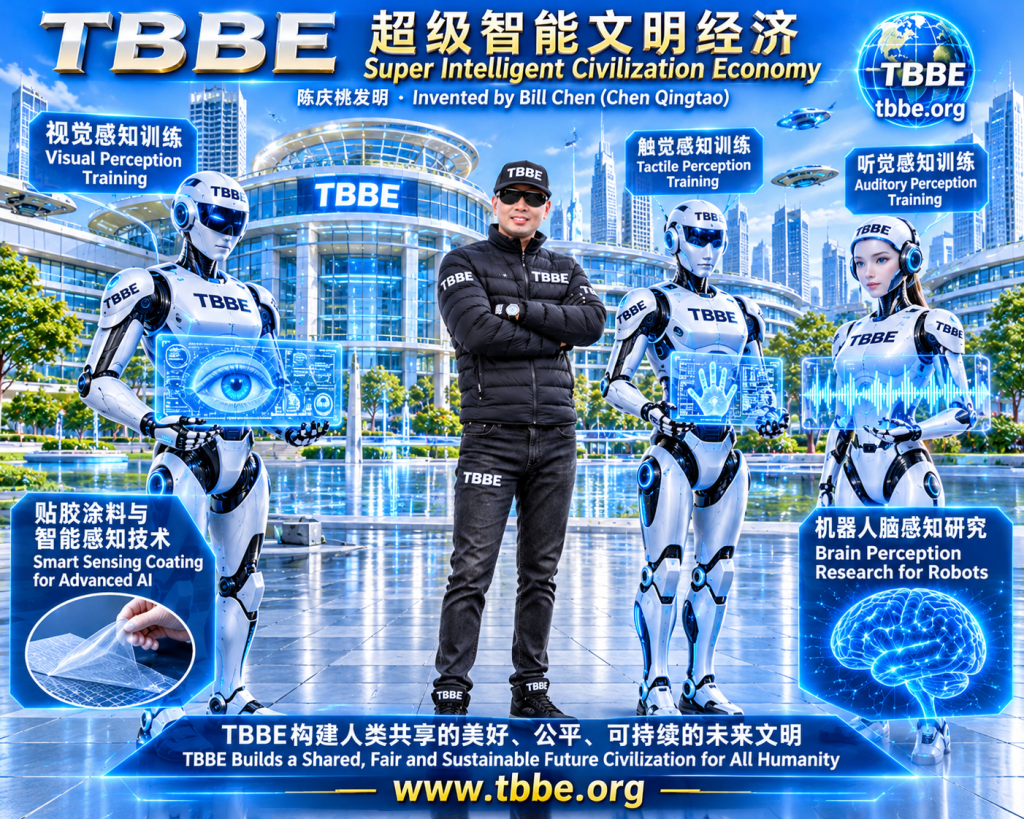
Theory Founder and Researcher: Qingtao Chen
1. A Major Research Concept
After years of research into artificial intelligence, robotics, and human brain information perception, Qingtao Chen proposes a promising research concept: developing special brain-sensing materials that could enable humans to communicate with and remotely train intelligent robots.
The proposed technology explores the use of special brainwave-sensing adhesive films, conductive gels, flexible materials, and miniature signal receivers to collect non-invasive electrical signals from the human brain.
These signals could be processed and interpreted by artificial intelligence systems and transmitted to remote robots, creating a new connection between human intelligence and robotic intelligence.
The goal is to explore a lightweight and comfortable approach that does not require brain surgery or conventional bulky headsets.
2. Special Brain-Sensing Materials and Robotic Connection Technology
TBBE proposes exploring a new generation of brain-sensing materials and technologies:
- Apply special brain-sensing adhesive films to appropriate areas of the human head.
- Use specially developed materials with suitable biocompatibility and electrical conductivity.
- Collect brain electrical activity through miniature sensors.
- Use artificial intelligence to recognize, analyze, and process the signals.
- Transmit interpreted and authorized commands to remote robots.
- Train robots through repeated interaction so they can gradually develop skills suited to human needs.
This research direction aims to make human-robot communication more accessible, convenient, and efficient.
3. Everyone Could Train Their Own Super-Intelligent Robot
TBBE envisions a new social application model in which individuals could use safe and lightweight brain-sensing devices to communicate their intentions, operational requirements, and trained commands to intelligent robots.
People could potentially train different types of robots according to their interests, abilities, and professional needs.
Examples include:
- Industrial Robots: Intelligent manufacturing and production.
- Agricultural Robots: Planting, farming, and harvesting.
- Marine Robots: Ocean exploration and resource development.
- Construction Robots: Intelligent infrastructure and city development.
- Medical Assistance Robots: Supporting healthcare professionals.
- Domestic Service Robots: Helping with everyday household activities.
- Scientific Research Robots: Supporting scientific discovery and technological innovation.
In the future, individuals could have access to intelligent robots suited to their professional abilities and work requirements.
This could reduce repetitive physical labor and allow people to dedicate more time to creativity, education, research, and civilization development.
4. Promoting a New Super-Intelligent Civilization Economy
TBBE considers the integration of brain-sensing technology and super-intelligent robotics an important potential direction for future economic development.
Through cooperation between human intelligence and artificial intelligence, this technology could help explore opportunities to:
- Improve overall social productivity.
- Reduce repetitive labor costs.
- Advance industrial and agricultural automation.
- Support ocean and space resource development.
- Create new occupations and employment opportunities.
- Expand career choices for people with different abilities.
- Upgrade education, scientific research, manufacturing, and service industries.
The combination of human intelligence, intelligent materials, and robotics could help establish new production models and economic opportunities.
5. The Ultimate Vision of TBBE
The TBBE Super-Intelligent Civilization Economy, proposed by Qingtao Chen, focuses not only on technological innovation but also on how humanity and intelligent machines can work together to create greater value.
The integration of brain-sensing materials, artificial intelligence, super-intelligent robots, and a new economic system could help establish an entirely new framework for intelligent production and social services.
In this vision:
- Humans contribute intelligence, creativity, decision-making, and innovation.
- Intelligent robots perform suitable automated and repetitive tasks.
- Artificial intelligence supports learning, communication, and productivity.
- New economic models create more opportunities and improve people’s quality of life.
Technology should serve humanity. Intelligence should create value. Economic development should benefit more people.
The ultimate goal of TBBE is to build a future civilization in which human intelligence and super-intelligent robots develop together, resources are used efficiently, production becomes highly intelligent, and human life becomes better.
TBBE — Connecting Human Intelligence with Super-Intelligent Machines to Create the Civilization of Tomorrow!
TBBE超级智能文明经济理论 第二十九期:非侵入式脑感知重大研究突破——利用特殊脑感知材料远程训练超级智能机器人
理论提出与研究者:陈庆桃
一、重大研究理念
陈庆桃经过多年来对人工智能、机器人技术和人脑信息感知领域的研究,提出了一项具有未来发展潜力的脑感知技术研究构想:利用特殊脑电感知材料、柔性贴膜、导电胶及信号接收装置,实现人与机器人之间的远程信息交流和训练。
这项研究的核心目标,是让人类不需要接受脑部手术,也不需要佩戴传统笨重的头盔,就有机会通过轻便的脑感知材料与超级智能机器人建立信息连接。
二、特殊脑感知材料与机器人连接技术
TBBE提出探索一种新型脑感知材料技术:
- 在人体头部适当位置粘接特殊脑电感知贴膜。
- 使用具有良好生物相容性和导电性能的特殊材料或导电胶。
- 通过微型传感器接收人体脑电活动信号。
- 利用人工智能系统识别、分析和处理信号。
- 将经过识别和授权的操作指令传输给远程机器人。
- 通过反复训练,让机器人逐步掌握适合人类需求的工作技能。
三、人人都可以训练自己的超级智能机器人
TBBE未来希望实现一个全新的社会应用模式:
每个人都可以通过安全、轻便的脑感知设备,把自己的工作意图、操作需求和经过训练的指令传递给机器人。
人类可以根据自己的兴趣、能力和工作需要,训练不同类型的超级智能机器人。
例如:
- 工业制造机器人:负责智能生产。
- 农业机器人:负责种植、管理和收获。
- 海洋机器人:负责海洋资源调查与开发。
- 建筑机器人:负责智能化城市建设。
- 医疗辅助机器人:协助医疗人员开展工作。
- 家庭服务机器人:帮助人们处理日常生活事务。
- 科研机器人:协助科学研究与技术创新。
四、推动新型超级智能文明经济发展
TBBE认为,脑感知技术与超级智能机器人的结合,将有机会成为未来新型经济发展的重要研究方向。
通过人类智慧与人工智能的协同合作,可以探索提高社会整体生产效率、降低重复性劳动成本、促进自动化生产、创造新型职业和就业机会。
五、TBBE最终发展目标
陈庆桃提出的TBBE超级智能文明经济理念,不仅关注机器人技术本身,更关注未来人类如何与智能机器共同创造更高价值。
让人类负责智慧、创造、决策和文明发展,让机器人承担更多适合自动化的工作。


Leave a Reply