提出人:陈庆桃|Proposed by Chen Qingtao
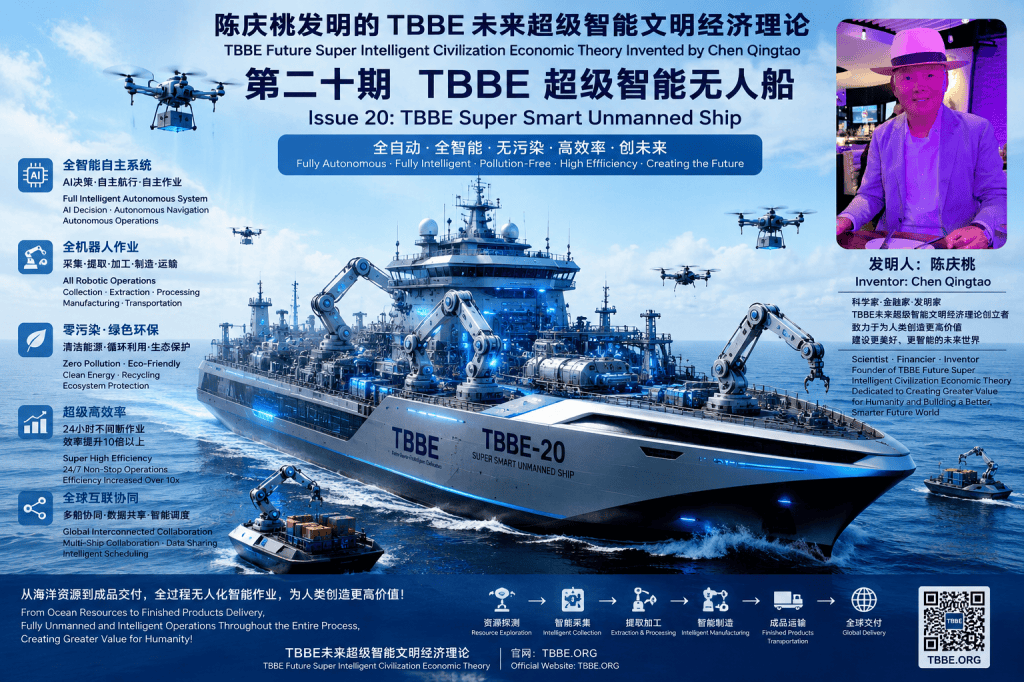
TBBE第二十期提出TBBE超级智能无人船的未来构想:利用人工智能、机器人、自动驾驶、无人机、智能制造和全球通信网络,把大型海洋平台建设成为集资源探索、采集、提取、加工、制造、运输和交付于一体的超级智能无人系统。
未来的海洋不仅是交通运输通道,也可以成为人类新的智能生产空间。
一、全智能自主系统
TBBE超级智能无人船以人工智能为核心,实现自主航行、自主避险、自主作业、智能决策和多船协同。通过传感器、卫星通信、无人机和智能控制系统,持续获得海洋环境和设备运行数据,并根据任务需求自动调整运行方案。
二、全机器人作业
无人船上的大量工作由机器人完成,包括资源探测、采集、提取、加工、制造、包装和运输。
大型机器人负责重型作业,精密机器人负责加工制造,无人机负责巡检和空中运输,小型无人船负责协同作业,从而形成完整的海上智能生产体系。
三、海上智能制造
TBBE超级智能无人船探索将部分制造能力从陆地延伸到海洋。
未来可以根据资源、能源和环境条件,在海上建立模块化智能制造系统,将原材料直接加工成为更高价值的产品,再通过无人运输网络送往陆地和全球市场。
形成:
资源探索 → 智能采集 → 提取加工 → 智能制造 → 成品运输 → 全球交付
的智能化流程。
四、绿色与低污染
TBBE强调海洋开发必须与生态保护相结合。
通过清洁能源、循环利用、智能能源管理、废物回收和自动化生产等技术,可以减少资源浪费和人为污染。
未来海洋经济的目标不是简单地开发更多资源,而是:
用更少的资源消耗创造更高的社会价值。
五、超级高效率
智能无人船可以根据任务需求进行连续运行,并通过人工智能进行设备监测、故障预测、自动维护和生产调度。
多艘无人船之间还可以共享数据、协同运输和优化任务,从而形成全天候、网络化的智能生产体系。
六、全球智能协同
TBBE超级智能无人船不是孤立的船舶,而是未来全球智能经济网络中的一个节点。
海上无人船、陆地智能工厂、无人机、智能物流系统和卫星通信网络可以互联协同,实现全球数据共享、资源优化配置、智能生产和智能运输。
最终形成:
海洋智能生产 + 陆地智能制造 + 全球智能物流
的新型文明经济体系。
七、为人类创造更高价值
TBBE第二十期的核心理念,是让机器承担更多危险、重复和高强度的生产工作,让人类把更多时间和精力用于科学、教育、文化、创造和文明发展。
让机器创造效率,让科技创造价值,让海洋服务人类文明。
TBBE Issue 20 proposes a future concept for the TBBE Super Smart Unmanned Ship—a large autonomous ocean platform integrating artificial intelligence, robotics, autonomous navigation, drones, smart manufacturing, and global communication networks.
The ship is envisioned as an integrated system capable of resource exploration, collection, extraction, processing, manufacturing, transportation, and delivery.
In the future, the ocean could become not only a transportation route, but also an important intelligent production space for human civilization.
1. Fully Intelligent Autonomous System
The TBBE Super Smart Unmanned Ship uses artificial intelligence as its central control system.
It is designed to support autonomous navigation, intelligent decision-making, collision avoidance, autonomous operations, and cooperation among multiple unmanned vessels.
Sensors, satellite communications, drones, and intelligent control systems continuously collect information about the ocean environment and equipment conditions, allowing the system to adjust operations according to changing tasks and conditions.
2. Fully Robotic Operations
A large portion of shipboard operations can be performed by intelligent machines.
Robots can support resource exploration, collection, extraction, processing, manufacturing, packaging, inspection, and transportation.
Large robotic arms can perform heavy operations, precision robots can handle manufacturing tasks, drones can conduct inspections and aerial transportation, and smaller unmanned vessels can provide coordinated support.
This creates an integrated intelligent marine production system.
3. Intelligent Manufacturing at Sea
The TBBE Super Smart Unmanned Ship explores the possibility of extending selected manufacturing capabilities from land into the ocean.
Depending on available resources, energy, technology, and environmental conditions, modular intelligent manufacturing systems could process raw materials at sea and transform them into higher-value products.
The products could then be transported to land and global markets through autonomous logistics networks.
The envisioned process is:
Resource Exploration → Intelligent Collection → Extraction & Processing → Intelligent Manufacturing → Finished Products → Global Delivery
4. Green and Low-Pollution Development
TBBE emphasizes that ocean development should be combined with environmental protection.
Clean energy, recycling, intelligent energy management, waste recovery, and automated production could help reduce unnecessary resource consumption and pollution.
The goal of the future marine economy should not simply be to extract more resources.
It should be:
Creating greater social value with fewer resources and less environmental impact.
5. Super High Efficiency
Intelligent unmanned ships could operate continuously according to mission requirements.
Artificial intelligence can monitor equipment, predict potential failures, support preventive maintenance, and optimize production schedules.
Multiple unmanned vessels could also share information, coordinate transportation, and dynamically allocate tasks, creating a highly connected and efficient intelligent production network.
6. Global Intelligent Collaboration
The TBBE Super Smart Unmanned Ship is envisioned not as an isolated vessel, but as a node within a future global intelligent economic network.
Unmanned ships, intelligent factories, drones, smart logistics systems, and satellite communication networks could work together to support global data sharing, resource optimization, intelligent manufacturing, and autonomous transportation.
The long-term vision is:
Intelligent Ocean Production + Intelligent Land Manufacturing + Global Intelligent Logistics
forming a new model for future civilization and economic development.
7. Creating Greater Value for Humanity
The central idea of TBBE Issue 20 is to allow intelligent machines to undertake more dangerous, repetitive, and physically demanding work, while enabling people to devote more time and energy to science, education, culture, creativity, and the development of civilization.
Let machines create efficiency.
Let technology create value.
Let the ocean serve the future of human civilization.


Leave a Reply