Executive Summary
As artificial intelligence, robotics, the Internet of Things (IoT), cloud computing, advanced materials, and sustainable energy technologies continue to evolve, human society is gradually transitioning from the digital era into the era of super-intelligent civilization.
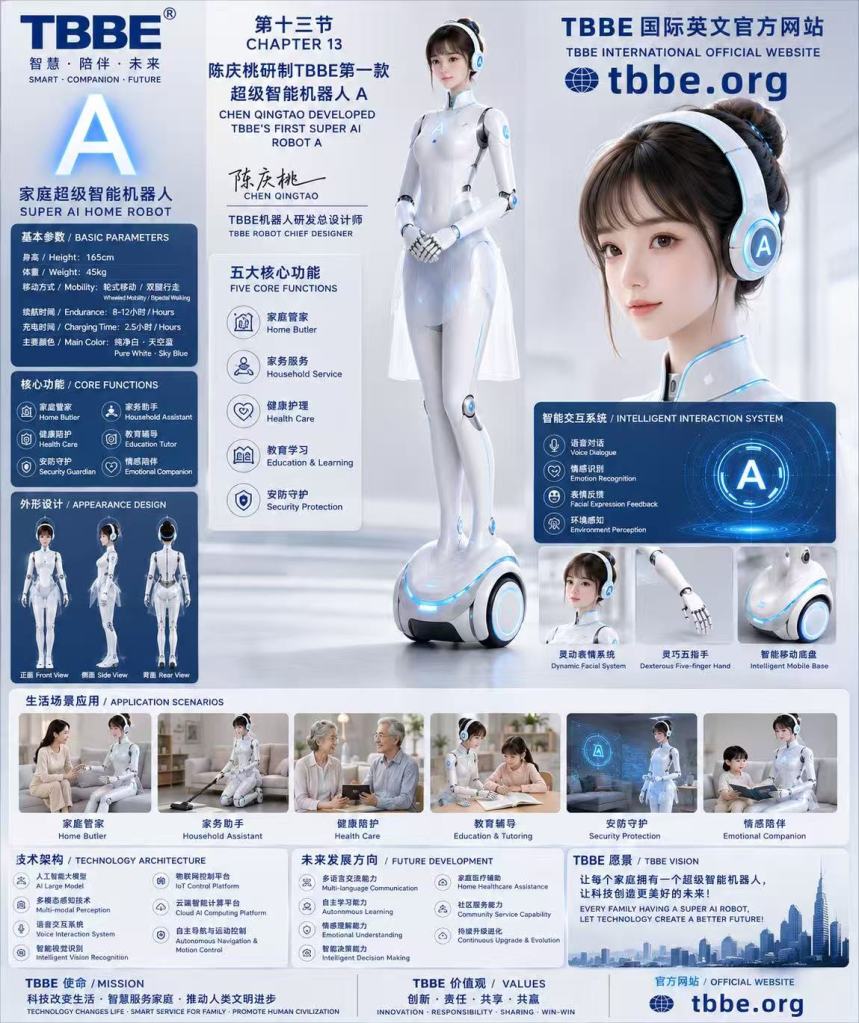
The family is the most fundamental unit of society and will become a key platform for future intelligent civilization. The TBBE Future Super Intelligent Home Robot A System is proposed under the framework of the TBBE Future Super Intelligent Civilization Economic Theory. Its mission is to improve quality of life, enhance household efficiency, support education and healthcare, and promote the coordinated development of technology, economy, and civilization.
Chapter 1: Research Background
Modern society faces numerous challenges, including population aging, rising healthcare costs, increasing educational demands, and growing pressure on family support systems.
Traditional household service models rely heavily on manual labor and are becoming increasingly inefficient in meeting future societal needs.
The TBBE theory proposes a new intelligent family ecosystem in which humans, intelligent robots, and intelligent networks collaborate to create safer, smarter, and more efficient living environments.
The development of future super-intelligent home robots is therefore of significant technological, economic, and social importance.
Chapter 2: Theoretical Foundation
The TBBE Future Super Intelligent Civilization Economic Theory is based on four core pillars:
– Economic Development as the Foundation
– Technological Innovation as the Driving Force
– Intelligent Systems as the Core Tool
– Civilizational Advancement as the Ultimate Goal
Future intelligent home robots should follow six fundamental principles:
1. Human-Centered Service
2. Safety and Reliability
3. Intelligent Collaboration
4. Green and Sustainable Development
5. Continuous Evolution
6. Open and Shared Innovation
Chapter 3: System Architecture
The TBBE Future Super Intelligent Home Robot A System consists of six core platforms:
1. Super Intelligent Perception Platform
Responsible for:
– Visual Recognition
– Voice Recognition
– Environmental Monitoring
– Biometric Identification
– Spatial Awareness
2. Super Intelligent Decision Platform
Responsible for:
– Data Analysis
– Knowledge Learning
– Task Planning
– Risk Assessment
– Autonomous Decision-Making
3. Super Intelligent Execution Platform
Responsible for:
– Mobility Operations
– Household Services
– Object Handling
– Daily Assistance Tasks
4. Super Intelligent Communication Platform
Enabling communication among humans, robots, cloud systems, and smart devices.
5. Super Intelligent Energy Platform
Providing efficient energy management and sustainable operation.
6. Super Intelligent Security Platform
Ensuring operational security, cybersecurity, and family safety.
Chapter 4: Core Functional Systems
Home Management Center
– Schedule Management
– Asset Management
– Smart Appliance Control
– Energy Optimization
Health Service Center
– Health Monitoring
– Wellness Assessment
– Remote Healthcare Assistance
– Elderly Care Support
Education and Learning Center
– Knowledge Assistance
– Language Learning
– Skill Development
– Lifelong Education Support
Family Security Center
– Fire Detection
– Gas Monitoring
– Security Patrol
– Emergency Response
Smart Logistics Center
– Household Inventory Management
– Intelligent Delivery Coordination
– Automated Service Operations
Emotional Companion Center
– Natural Language Communication
– Emotional Support
– Cultural Interaction
– Entertainment Services
Chapter 5: Technology Development Directions
Future development of TBBE Home Robot A will focus on:
– Advanced Artificial Intelligence Models
– Multimodal Perception Technologies
– Autonomous Navigation Systems
– Human-Robot Interaction Technologies
– Collaborative Robotics
– Digital Twin Technologies
– Smart Energy Systems
– Cloud-Based Super Computing
These technologies will jointly create a next-generation intelligent home service ecosystem.
Chapter 6: Economic Value
The future intelligent home robotics industry is expected to become a major pillar of the intelligent economy.
Its economic benefits include:
– Increasing Household Productivity
– Reducing Service Costs
– Promoting Intelligent Manufacturing
– Accelerating AI Industry Development
– Supporting Advanced Materials Innovation
– Creating New Economic Growth Opportunities
Future home robots may become one of the key infrastructures of the intelligent civilization economy.
Chapter 7: Social Value
The TBBE Future Super Intelligent Home Robot A System aims to:
– Improve Quality of Life
– Enhance Elderly Care Services
– Expand Educational Accessibility
– Strengthen Public Safety
– Promote Smart Community Development
– Foster Harmonious Human-Technology Relationships
The ultimate objective is to contribute to a safer, smarter, more efficient, and more sustainable society.
Chapter 8: Future Development Roadmap
Phase One
Smart Home Assistant
Phase Two
Comprehensive Household Service Robot
Phase Three
Intelligent Home Ecosystem
Phase Four
Smart Community Collaboration Network
Phase Five
Super Intelligent Civilization Home System
Phase Six
Global Super Intelligent Civilization Network
Conclusion
The TBBE Future Super Intelligent Home Robot A System represents an important practical application of the TBBE Future Super Intelligent Civilization Economic Theory.
This white paper provides a comprehensive framework, technological roadmap, and application model for future intelligent home development.
As technology continues to advance, intelligent home robots are expected to become a critical bridge connecting technology, economy, and civilization, helping create a better future for humanity.
Initiator: Chen Qingtao
Research Program: TBBE Future Super Intelligent Civilization Economic Theory
Official White Paper – Chapter 13
Version 1.0 | 2026


Leave a Reply