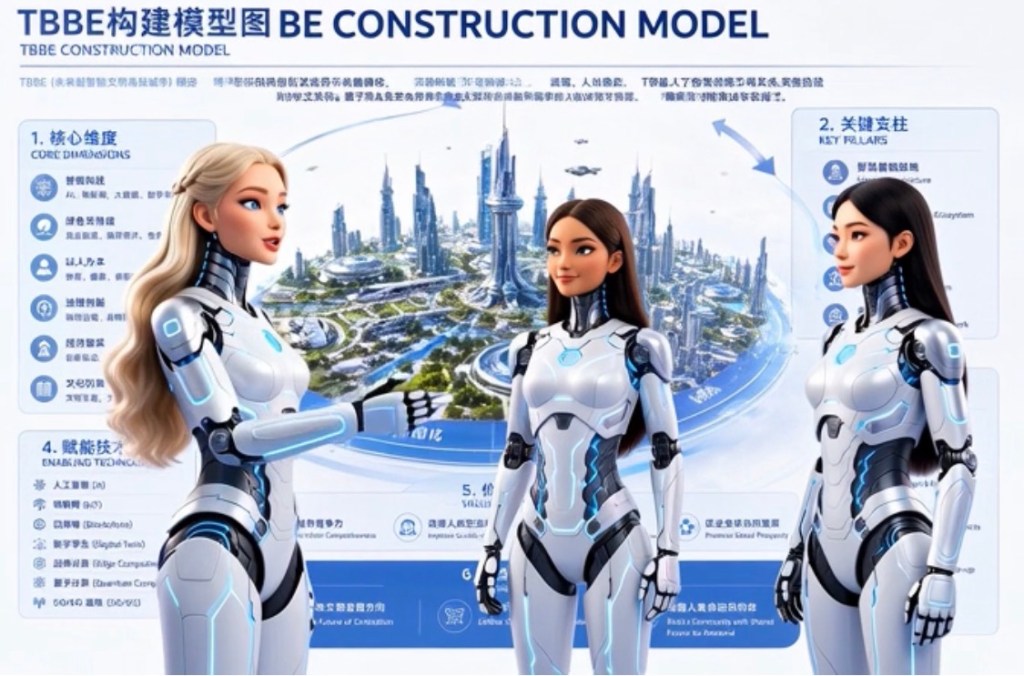
The TBBE Super Intelligent City Construction Model is a future-oriented urban development framework based on the principles of the TBBE Future Super Intelligent Civilization Economic Theory. Its purpose is to create a highly efficient, intelligent, sustainable, and human-centered civilization through the integration of advanced technologies, intelligent systems, ecological sustainability, and innovative economic structures.
Unlike traditional cities, where infrastructure and management systems often operate independently, the TBBE model proposes a fully integrated urban ecosystem. Artificial intelligence, robotics, the Internet of Things (IoT), digital twins, renewable energy, and intelligent transportation networks work together as a unified system to optimize city operations and improve the quality of life for all residents.
1. Overall Architecture of the TBBE Super Intelligent City
The city is built upon eight core intelligent systems:
1. Super Intelligent Economic System
2. Super Intelligent Energy System
3. Super Intelligent Transportation System
4. Super Intelligent Education System
5. Super Intelligent Healthcare System
6. Super Intelligent Ecological and Environmental System
7. Super Intelligent Cultural and Community System
8. Super Intelligent Governance and Management System
These systems are connected through a central AI platform known as the “City Brain,” enabling real-time coordination, analysis, prediction, and decision-making.
2. Super Intelligent Economic System
The future economy will be driven by innovation, automation, and intelligent resource allocation. Advanced AI systems continuously analyze market demand, production capacity, technological development, and social needs.
Research institutions, intelligent manufacturing centers, technology enterprises, and robotics industries form the foundation of economic growth, creating a highly productive and sustainable economic environment.
3. Super Intelligent Transportation Network
The TBBE model proposes a three-dimensional transportation structure consisting of underground, ground-level, and aerial transportation systems.
Autonomous vehicles, intelligent rail systems, logistics robots, drone delivery networks, and AI traffic management platforms operate together to maximize efficiency, reduce congestion, and minimize environmental impact.
4. Super Intelligent Energy System
Future cities will rely primarily on renewable and clean energy sources, including solar power, wind energy, advanced energy storage systems, and next-generation sustainable technologies.
An intelligent energy network automatically balances supply and demand, maximizing efficiency while reducing waste and carbon emissions.
5. Super Intelligent Ecological Environment System
Environmental sustainability is a fundamental principle of the TBBE model.
Vertical forests, smart green buildings, urban ecological parks, intelligent water management systems, and advanced recycling technologies help create a clean, healthy, and low-carbon living environment.
6. Super Intelligent Robotics Service System
Robots will become important partners in future urban life.
Service robots, healthcare robots, educational robots, engineering robots, security robots, and household robots will perform repetitive, dangerous, and labor-intensive tasks, allowing people to focus on creativity, learning, innovation, and social development.
7. Super Intelligent Community Life System
Every community is designed to provide comprehensive intelligent services.
Residents will benefit from advanced healthcare facilities, intelligent education platforms, personalized public services, smart housing systems, and innovative recreational environments.
Children, adults, and senior citizens will all enjoy equal access to high-quality public resources and opportunities.
8. The TBBE City Brain
The City Brain serves as the central intelligence of the entire urban system.
Millions of sensors, IoT devices, and AI platforms continuously collect and analyze data from every aspect of city operations. Through predictive analytics and autonomous decision-making, the City Brain enhances efficiency, safety, sustainability, and public service quality.
9. Strategic Objectives of the TBBE Super Intelligent City
The primary goals include:
– Building a zero-pollution green city.
– Creating a highly efficient intelligent economy.
– Improving human well-being and quality of life.
– Establishing fair and accessible public services.
– Promoting harmony between humanity and nature.
– Supporting sustainable long-term development.
– Advancing global civilization through technology and innovation.
Conclusion
The TBBE Super Intelligent City Construction Model, invented, researched, and designed by Chen Qingtao, represents a visionary framework for future urban civilization. By integrating advanced technologies, intelligent governance, sustainable development, and human-centered design, the model seeks to create a new generation of cities that are cleaner, smarter, safer, and more prosperous.
As a key component of the TBBE Future Super Intelligent Civilization Economic Theory, this model provides a long-term conceptual roadmap for governments, universities, research institutions, enterprises, and future generations seeking to build a more advanced and harmonious civilization.
 TBBE
TBBE 
Leave a comment