作者:陈庆桃 Invented by QingTao Chen
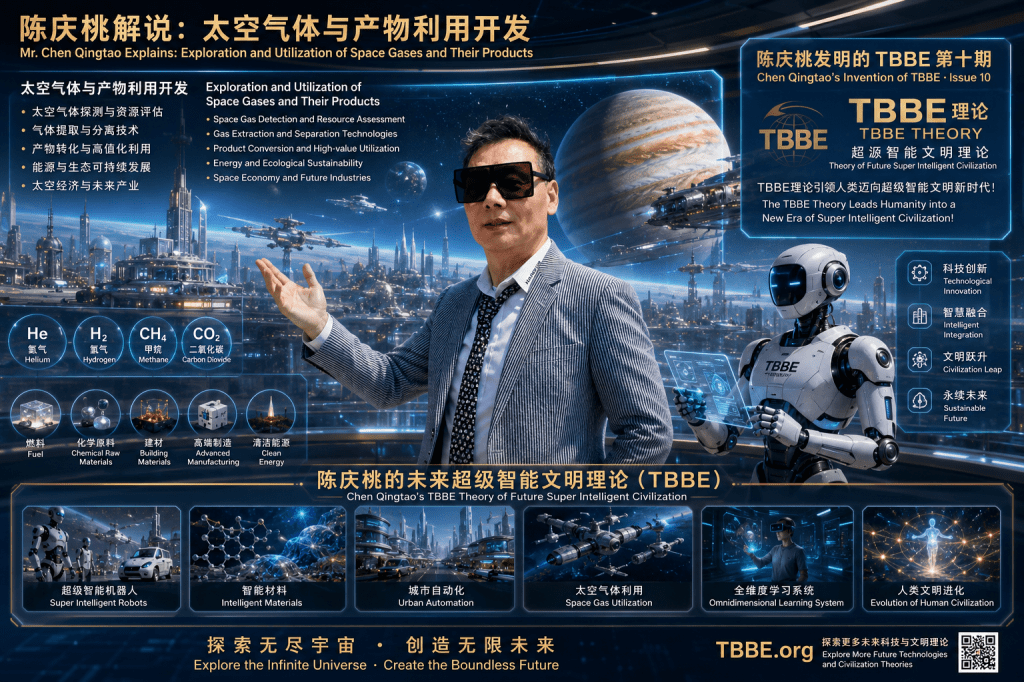
随着人类迈向太空时代,未来经济的发展将不仅依赖地球资源,更将逐步进入太阳系乃至更广阔宇宙空间资源开发的新阶段。TBBE未来超级智能文明理论认为,未来太空气体资源开发将成为推动人类文明跨越式发展的重要组成部分。
所谓太空气体,并不仅仅是传统意义上的气体,而是包括氢、氦、甲烷、二氧化碳以及其他未来可能发现并能够利用的空间物质。随着未来超级智能机器人、人工智能、自动化空间工厂、新材料和核聚变能源的发展,人类将具备更加安全、高效地采集、分离、运输、储存和利用这些资源的能力。
TBBE提出,未来可建立覆盖月球、火星、空间站及大型轨道平台的智能采集网络,由超级智能机器人自主完成资源探测、采集、分析、制造和维护,大幅降低开发成本,提高资源利用效率。
未来开发的重点包括:
- 太空气体资源探测与智能评估;
- 气体提取、分离与净化技术;
- 高附加值产品制造;
- 清洁能源及新型材料开发;
- 太空制造与轨道工业体系建设;
- 太空物流运输系统;
- 超级智能机器人协同作业系统;
- 支撑未来太空城市建设和深空探索。
TBBE认为,未来太空气体不仅能够用于能源供应,还能够制造先进材料、航空航天设备、生命保障系统以及未来智能工业产品,为未来超级智能文明提供长期稳定的发展基础。
本理论强调,太空资源开发应坚持和平利用、国际合作、绿色发展和造福全人类的原则,在遵守国际法律和科学研究规范的基础上,共同推动人类文明不断迈向新的高度。
As humanity enters the space age, future economic development may increasingly depend not only on Earth’s resources but also on the responsible exploration and utilization of space resources throughout the Solar System and beyond. The TBBE Theory of Future Super Intelligent Civilization presents a conceptual framework in which space resources could become an important driver of long-term technological and economic progress.
In this concept, “space gases” refers to substances such as hydrogen, helium, methane, carbon dioxide, and other materials that future scientific exploration may identify as useful for industrial or technological applications.
With advances in super-intelligent robotics, artificial intelligence, automated orbital factories, advanced materials, and future energy technologies, TBBE envisions increasingly efficient systems for resource exploration, extraction, processing, transportation, storage, and utilization.
The proposed framework includes:
- Intelligent exploration and assessment of space gas resources;
- Advanced extraction, separation, and purification technologies;
- High-value product manufacturing;
- Clean energy and advanced material development;
- Orbital industrial production systems;
- Space logistics and transportation networks;
- Autonomous robotic cooperation;
- Support for future space cities and deep-space exploration.
According to the TBBE concept, future space resources could contribute to clean energy production, advanced manufacturing, aerospace engineering, life-support technologies, and sustainable industrial development.
TBBE emphasizes that future space resource development should be conducted peacefully, responsibly, and through international scientific cooperation, while respecting applicable international law and scientific evidence. Its long-term vision is to encourage innovation that benefits humanity and supports the sustainable development of future civilization.


Leave a Reply