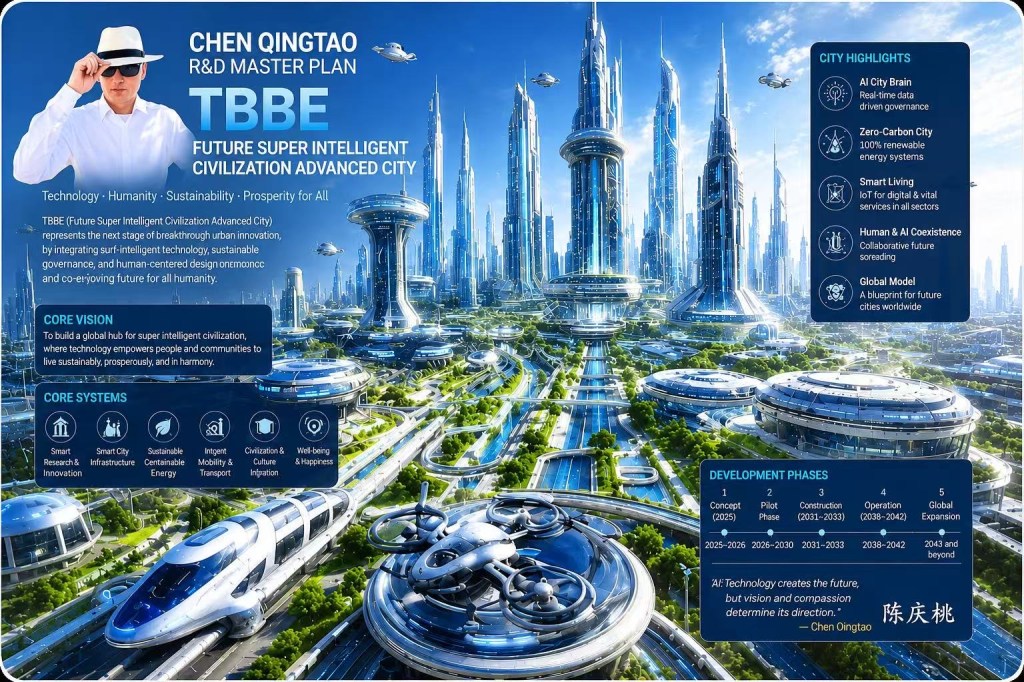
According to the TBBE Future Super Intelligent Cultural and Economic Theory, future cities will no longer be simple collections of buildings and populations. Instead, they will become highly integrated intelligent civilization complexes composed of economic systems, technological systems, cultural systems, ecological systems, energy systems, and intelligent governance systems.
The goal of future urban development is not only economic growth, but also the improvement of operational efficiency, quality of life, scientific innovation, and the overall level of human civilization.
1. Core Systems of the Super Intelligent City
The future super intelligent civilization city consists of six core systems:
1. Super Intelligent Economic System
2. Super Intelligent Technology System
3. Super Intelligent Cultural System
4. Super Intelligent Ecological System
5. Super Intelligent Energy System
6. Super Intelligent Governance System
These six systems are interconnected through advanced artificial intelligence networks, creating a dynamic, self-learning, self-optimizing, and highly efficient urban ecosystem.
2. Future Urban Spatial Structure
The TBBE theory proposes the concept of a “Four-Dimensional Integrated City.”
Underground Infrastructure Layer
This layer includes underground transportation systems, logistics networks, energy storage facilities, and intelligent utility pipelines.
Ground-Level Living Layer
This area contains residential communities, commercial districts, schools, hospitals, parks, and cultural facilities.
Aerial Transportation Layer
Future cities will utilize autonomous aerial vehicles, intelligent air logistics systems, and urban aviation networks to improve transportation efficiency.
Digital Space Layer
Through digital twin technology, a virtual city will operate alongside the physical city, enabling real-time monitoring, simulation, and intelligent decision-making.
3. Future Intelligent Transportation System
Transportation serves as the foundation of urban development.
Future transportation systems will include:
– Autonomous vehicles
– Intelligent public transit
– Automated logistics networks
– Low-altitude aerial transportation
– Ultra-high-speed rail systems
A centralized intelligent management platform will coordinate all transportation resources to ensure safety, efficiency, and low energy consumption.
4. Future Cultural Innovation Centers
Culture is one of the key driving forces of urban competitiveness.
TBBE Future Cities will establish:
– World Cultural Exchange Centers
– Future Arts and Creativity Centers
– Digital Civilization Museums
– Technology Innovation Exhibition Centers
– International Academic Exchange Institutes
These institutions will promote deep integration between technology and culture, transforming cultural creativity into a major driver of economic growth.
5. Future Intelligent Communities
Communities form the foundation of urban civilization.
Future intelligent communities will provide:
– Smart healthcare services
– Intelligent education systems
– Smart elderly care services
– Intelligent property management
– Advanced public safety systems
Artificial intelligence will enhance service quality and improve residents’ well-being and quality of life.
6. Future Economic Development Model
The TBBE theory emphasizes that economic development must be driven by technological innovation.
Priority industries include:
– Intelligent robotics
– Renewable energy
– Advanced materials
– Biotechnology
– Digital economy
– Aerospace technology
– Cultural and creative industries
Together, these sectors will form a sustainable, innovation-driven, and high-quality economic ecosystem.
7. Vision for Future Civilization
The objective of the Future Super Intelligent Civilization City is not simply urban expansion, but the advancement of human civilization.
Its ultimate vision is to create a city that is:
– Technologically advanced
– Economically prosperous
– Culturally vibrant
– Environmentally sustainable
– Socially harmonious
– Beneficial to all citizens
The TBBE theory suggests that humanity is gradually entering the era of Super Intelligent Civilization, and future cities will become the primary platforms for realizing this transformation.
Conclusion
The construction of Future Super Intelligent Civilization Cities is a comprehensive undertaking that integrates economic development, technological innovation, cultural prosperity, and ecological sustainability.
The TBBE Future Super Intelligent Cultural and Economic Theory seeks to provide a new framework for future urban development, offering innovative ideas and long-term visions that contribute to the progress of human civilization and the creation of a more advanced, intelligent, and sustainable future.


Leave a Reply