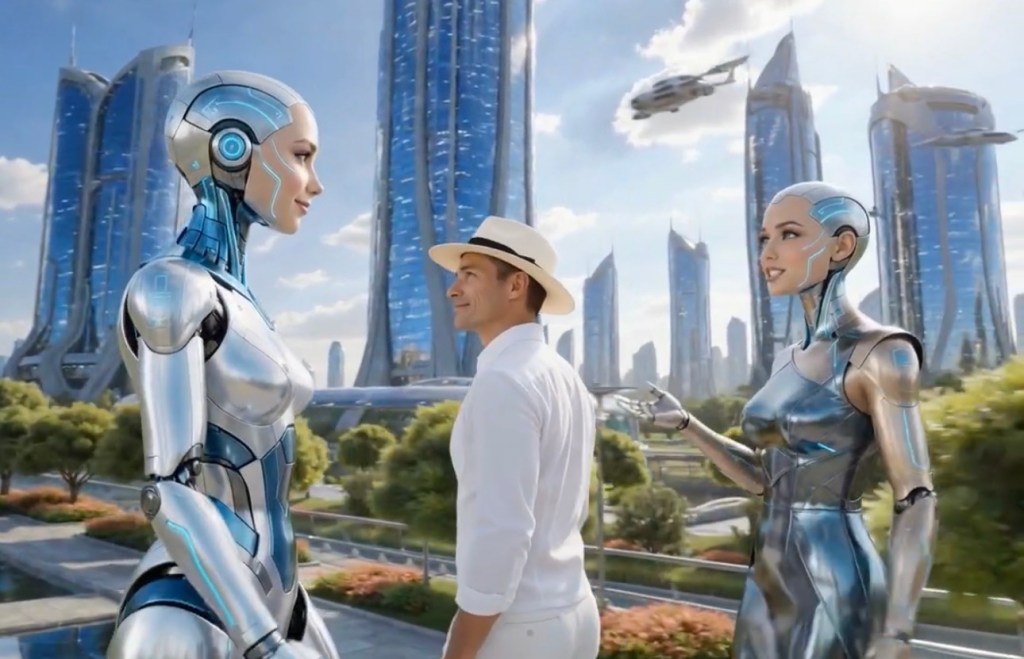
Within the framework of the TBBE Future Super-Intelligent Economic Theory, the ultimate goal of human development is not the endless accumulation of money, but the creation of a more efficient, fair, intelligent, and sustainable civilization.
Chapter 17 introduces a forward-looking concept: in future super-intelligent societies, economic exchange may gradually evolve beyond traditional monetary systems toward an Energy Contribution Sharing Model.
The term “energy” in this theory does not refer solely to physical energy or electricity. Instead, it represents the total value created through human activities, including labor, knowledge, innovation, creativity, education, scientific research, social services, environmental protection, and intelligent system operations.
In a future super-intelligent civilization, every individual can become a contributor to society through their unique abilities, interests, and activities.
Scientists create value through innovation and discovery.
Engineers create value through design and technological development.
Teachers create value through education and knowledge sharing.
Artists create value through cultural and creative contributions.
Elderly citizens create value through wisdom, experience, and mentorship.
Children create future value through learning, growth, and human potential.
Volunteers create value through community service and social engagement.
Under this model, people are no longer viewed simply as consumers, but as active creators of social value and participants in a shared civilization.
TBBE proposes that future super-intelligent systems, supported by artificial intelligence, advanced computing, intelligent networks, and the Internet of Things, will be capable of recognizing, evaluating, and coordinating various forms of human contribution.
The value generated by individuals may be transformed into a form of intelligent social credit or participation right, representing their contribution to society and their access to shared resources.
This concept differs from traditional currency. Instead of focusing solely on financial wealth, it emphasizes the creation and sharing of real social value.
As technology and productivity continue to advance, many essential services may become highly automated and universally accessible, including:
Housing support;
Healthcare services;
Education resources;
Transportation systems;
Basic food supply;
Public cultural services.
With abundance created through intelligent production systems, people may spend less time competing for survival and more time pursuing innovation, creativity, scientific exploration, lifelong learning, family life, and personal fulfillment.
The elderly would continue to play an important role in society. Their accumulated knowledge and life experience would be recognized as valuable social assets.
Children would receive opportunities for development regardless of economic background, allowing talent and potential to flourish more equally across society.
TBBE emphasizes that the future objective of civilization is not unlimited consumption, but the intelligent optimization of resources.
Future super-intelligent systems could dynamically balance population needs, resource availability, environmental sustainability, and economic activity, reducing waste while maximizing social well-being.
Within such a civilization:
Resources become more fairly distributed.
The environment becomes cleaner and healthier.
Technology becomes more advanced.
Daily life becomes easier and more enjoyable.
Society becomes more stable and cooperative.
Human civilization becomes more enlightened and sustainable.
Chapter 17 of the TBBE Theory suggests that one characteristic of advanced future civilizations may be a gradual transition from a Money-Driven Economy to a Value-Contribution Economy.
This concept represents not only an economic innovation but also an exploration of humanity’s long-term developmental path.
TBBE Future Super-Intelligent Economic Theory envisions a future in which technology, intelligence, economics, and civilization are deeply integrated, creating a more free, efficient, shared, and sustainable world for all humanity.
 TBBE
TBBE 
Leave a comment