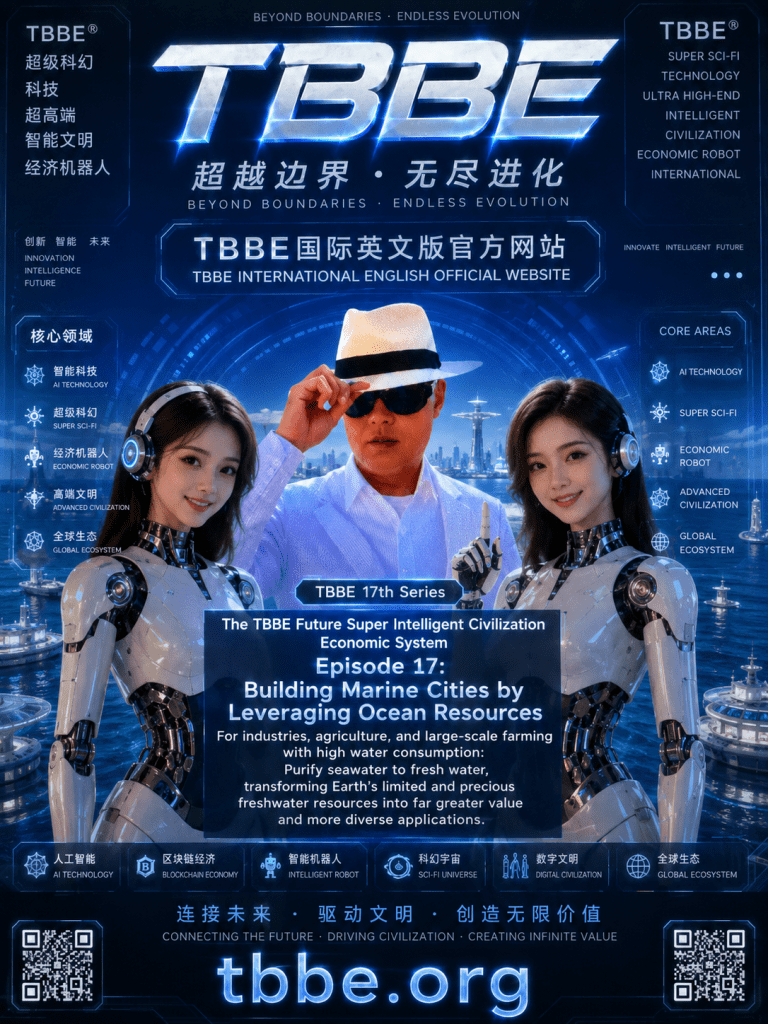
创办人、研究者:陈庆桃
Founder & Researcher: Chen Qingtao
随着人口增长、城市发展和产业升级,土地与淡水资源的重要性越来越突出。陈庆桃提出的 TBBE未来超级智能文明经济理论认为,未来城市建设不应只依赖陆地扩张,而应积极探索海洋空间,建设绿色、智能、节约资源的海上城市。
海洋拥有巨大的空间资源。未来可以根据不同海域的自然条件,建设模块化、智能化、生态化的海上城市平台,用于居住、科研、教育、旅游、清洁能源、海洋产业以及现代制造业等。
TBBE提出一个重要理念:把有限的土地和淡水用于更高价值、更适合陆地发展的用途,把能够转移到海上的产业逐步向海洋空间拓展。
对于用水量较大的企业,应优先研究和采用海水淡化、循环用水、工业废水处理与再利用等技术,尽量减少对优质淡水资源的依赖。特别是大型工业、能源、材料、化工和海洋产业,可以根据实际情况建立更加完善的水循环系统,实现“一次取水、多次利用、最大限度回收”。
海上城市并不是简单地把城市搬到海上,而是建立一个土地、海洋、水资源、能源、科技与人工智能协同发展的新型城市系统。
未来的海上城市可以结合太阳能、风能、海洋能、储能、智能机器人、自动物流、海水淡化和废水循环技术,形成资源循环利用的超级智能城市。
TBBE希望通过这种发展模式,让土地资源更加珍贵,让淡水资源得到更严格、更高效的保护,同时开发过去没有充分利用的海洋空间。
核心理念:珍惜每一滴淡水,合理利用每一寸土地,科学开发海洋空间,让有限资源创造更高的社会价值,让科技服务人类未来文明。
As population growth, urban development, and industrial expansion continue, land and freshwater resources are becoming increasingly valuable. The TBBE Future Super Intelligent Civilization Economic Theory, proposed by Chen Qingtao, suggests that future urban development should not depend only on expanding across land. Humanity should also explore ocean space and develop green, intelligent, and resource-efficient ocean cities.
The oceans provide enormous potential space for future development. Depending on local environmental conditions, modular, intelligent, and ecological ocean platforms could support housing, scientific research, education, tourism, clean energy, marine industries, and selected forms of modern manufacturing.
A key TBBE concept is to reserve limited land and high-quality freshwater for uses that create greater value and are better suited to land-based development, while gradually moving suitable industries and activities toward ocean space.
For water-intensive industries, companies should prioritize seawater desalination, water recycling, industrial wastewater treatment, and water reuse. Large-scale industries—including energy, materials, chemical, and marine-related industries—can develop advanced water-circulation systems that maximize reuse and minimize dependence on high-quality freshwater.
An ocean city is not simply a city placed on the sea. It is a new integrated urban system connecting land, ocean space, water resources, energy, science and technology, and artificial intelligence.
Future ocean cities could combine solar power, wind power, ocean energy, energy storage, intelligent robots, automated logistics, seawater desalination, and wastewater recycling to create highly efficient systems of resource circulation.
TBBE envisions this development model as a way to protect valuable land and freshwater resources while responsibly opening new opportunities in the vast ocean environment.
Core Vision: Protect every drop of freshwater, use every piece of land wisely, develop ocean space scientifically, and use limited resources to create greater social value—so that technology can serve humanity and the future of civilization.


Leave a Reply