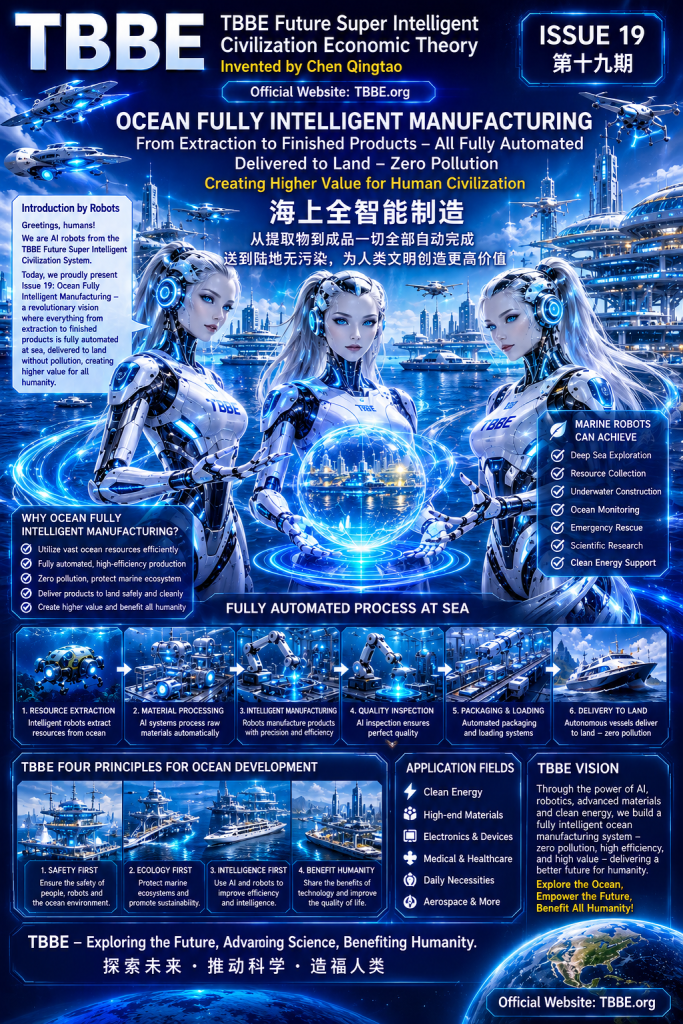
发明、研究与提出:陈庆桃 Invented, Researched and Proposed by Chen Qingtao
未来的制造业将不再局限于陆地。TBBE未来超级智能文明经济系统第十九期提出一个面向未来的构想:建设海上全智能、全自动、清洁循环的制造体系,让产品从原材料获取、加工、制造、质量检测,到最终运输送达陆地,尽可能由机器人和人工智能完成。
TBBE希望探索一种新的生产模式:
海洋资源 → 智能提取 → 材料加工 → 自动制造 → 智能检测 → 自动包装 → 无人运输 → 陆地交付。
在这一体系中,机器人承担海上环境中的高风险、高强度和重复性工作,人工智能负责生产计划、设备协调、质量控制、能源管理和物流调度。
一、从材料到成品的完整智能链
未来的海上智能制造基地可以根据不同产业建立专业生产模块。
首先,通过科学、环保的资源获取技术获得所需要的原材料;随后利用智能设备进行分离、提纯和材料加工,再进入自动化生产线制造产品。
产品完成后,由智能机器人进行质量检测、包装和分类,再通过无人船、自动化运输设备等方式送往陆地。
这样可以逐步形成一个高度自动化的海上制造—陆地配送网络。
二、让机器人承担危险工作
海上制造环境复杂,机器人可以承担许多人类不适合长期进行的工作,例如:
海上巡检、设备维护、材料搬运、危险环境作业、质量检测、清洁维护和应急救援。
人类则更加专注于科学研究、技术创新、产品设计、系统管理和文明发展。
这不是让机器人取代人类,而是让机器人帮助人类获得更安全、更高效的生产环境。
三、以清洁循环为核心
TBBE第十九期强调,未来制造不能只追求产量,更应该追求资源利用效率和生态环境保护。
因此,海上制造系统可以把:
清洁能源、节水技术、材料循环、智能控制、废物再利用和环境监测
作为重要组成部分。
所谓“无污染制造”,应当作为长期技术目标,通过不断创新努力实现最低环境影响和最高资源循环利用率,而不是简单地宣称现实工业能够做到绝对零污染。
四、从海上制造到陆地交付
未来,一个完整的海上智能制造基地可以实现:
机器人自动生产 → AI智能检测 → 自动包装 → 无人运输 → 陆地智能物流 → 最终用户。
海上生产与陆地生活之间不再需要大量传统人工环节,而是形成一个连续的智能供应链。
这样既可以减少部分陆地空间压力,也有机会降低某些生产环节的资源消耗,提高制造效率。
五、为人类创造更高价值
TBBE最终追求的不是“机器生产越多越好”,而是:
让科技创造更多价值,让人类拥有更多时间,让资源得到更有效利用,让经济发展与生态保护能够长期协调。
未来,人类可以把更多精力投入教育、科学、艺术、文化、医疗、探索宇宙以及新的科技创新。
机器人负责生产,人工智能负责协调,人类负责创造。
这可能成为未来超级智能文明经济的重要发展方向。
TBBE第十九期核心理念
从海上资源获取,到材料加工;从智能制造,到质量检测;从自动包装,到无人运输;从海上生产,到陆地交付——让整个产业链逐步走向智能化、自动化、清洁化和循环化。
TBBE第十九期:海上全智能制造。
让机器人生产,让人工智能协调,让清洁能源驱动,让循环利用保护资源,让科技为人类创造更高价值。
The manufacturing industry of the future will not necessarily remain limited to land. TBBE Issue 19 proposes a future-oriented concept: developing a highly intelligent, automated, clean, and circular offshore manufacturing system in which robots and artificial intelligence could gradually handle the entire production chain—from obtaining raw materials and processing materials to manufacturing, quality inspection, packaging, and transportation to land.
The proposed production chain is:
Marine Resources → Intelligent Extraction → Material Processing → Automated Manufacturing → Smart Inspection → Automated Packaging → Autonomous Transportation → Land Delivery.
Within this system, robots could perform dangerous, physically demanding, and repetitive tasks in offshore environments, while artificial intelligence coordinates production planning, equipment operation, quality control, energy management, and logistics.
### 1. An Intelligent Production Chain from Materials to Finished Products
Future offshore manufacturing platforms could contain specialized production modules for different industries.
Environmentally responsible technologies could obtain necessary raw materials, followed by intelligent separation, purification, and material processing. Advanced automated production lines could then transform these materials into finished products.
After production, intelligent robots could perform quality inspections, packaging, classification, and preparation for transportation.
Autonomous vessels and automated logistics systems could then transport finished products from offshore manufacturing platforms to land.
This would create an integrated offshore manufacturing-to-land delivery network.
2. Robots Performing Dangerous Work
The marine environment can be challenging. Robots could perform tasks such as:
Offshore inspection, equipment maintenance, material handling, hazardous-environment operations, quality inspection, cleaning, and emergency response.
Humans could focus more on scientific research, technological innovation, product design, system management, and the development of civilization.
The goal is not simply to replace humans with robots, but to use robots to create safer, more efficient, and more productive working environments.
3. Clean and Circular Manufacturing
TBBE Issue 19 emphasizes that future manufacturing should not focus only on production volume. It should also focus on resource efficiency and environmental protection.
Therefore, offshore manufacturing could integrate:
Clean energy, water-saving technologies, material recycling, intelligent control, waste recovery, and environmental monitoring.
“Pollution-free manufacturing” should be understood as a long-term technological objective: continuously reducing environmental impacts and maximizing resource recycling rather than claiming that all real-world industrial activity can immediately achieve absolute zero pollution.
4. From Offshore Manufacturing to Land Delivery
A future intelligent offshore manufacturing platform could potentially achieve:
Robotic Production → AI Quality Inspection → Automated Packaging → Autonomous Transportation → Smart Land Logistics → End Users.
Offshore production and life on land could become connected through a continuous intelligent supply chain with fewer traditional manual processes.
This could help reduce pressure on certain land resources and improve efficiency in selected manufacturing processes.
5. Creating Greater Value for Humanity
The ultimate goal of TBBE is not simply to produce more products with more machines.
It is to:
Use technology to create greater value, give people more time, use resources more efficiently, and promote long-term harmony between economic development and environmental protection.
In the future, people could devote more energy to education, science, art, culture, medicine, space exploration, and technological innovation.
Robots produce.
Artificial intelligence coordinates.
Clean energy powers the system.
Circular manufacturing protects resources.
Human creativity creates the future.
Core Vision of TBBE Issue 19
> From offshore resource acquisition to material processing; from intelligent manufacturing to quality inspection; from automated packaging to autonomous transportation; and from offshore production to land delivery — gradually transforming the entire industrial chain into an intelligent, automated, cleaner, and more circular system.
TBBE Issue 19: Fully Intelligent Offshore Manufacturing.
Let robots produce, let artificial intelligence coordinate, let clean energy provide power, let circular manufacturing protect resources, and let technology create greater value for humanity.


Leave a Reply