The TBBE Future Super Intelligent Civilization Economic Theory proposes that the ocean is not only an essential part of Earth’s ecological system, but also an important future space for humanity to obtain living resources and develop sustainable production.
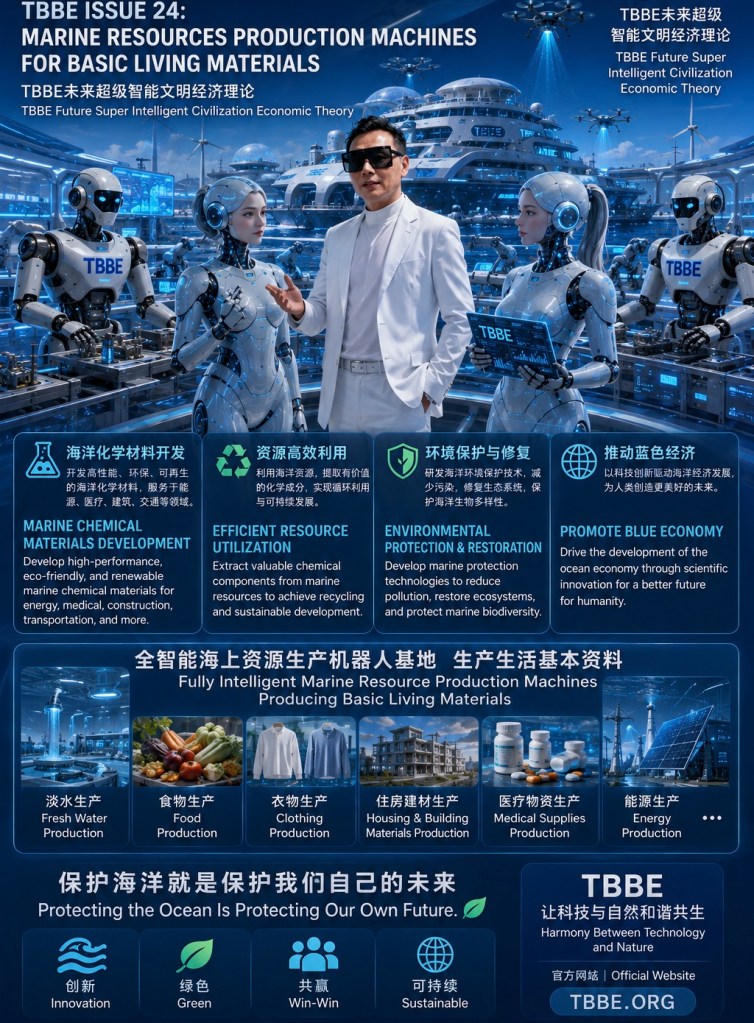
Issue 24: “Ocean Resources for Producing Essential Living Materials” proposes that, with artificial intelligence, robotics, clean energy, advanced materials technology, and intelligent manufacturing systems, humanity can scientifically and sustainably utilize ocean resources while protecting marine ecosystems.
Future intelligent ocean production systems could transform seawater, marine biological resources, and selected seabed mineral resources into useful materials for human life through advanced technologies. These may include fresh water, food, basic materials, energy, and certain industrial and household products.
Advanced desalination systems could provide fresh water for offshore cities and coastal communities. Intelligent ocean farms could produce seafood and other food resources. Robots could perform resource collection, transportation, processing, and manufacturing, reducing dangerous and physically demanding human labor. Clean energy could provide sustainable power for the entire system.
TBBE emphasizes that ocean resource development must always be based on ecological protection. Development activities should include environmental monitoring, pollution prevention, resource recycling, and ecological restoration in order to prevent overfishing, marine pollution, and uncontrolled exploitation.
In the future, super intelligent networks could connect offshore cities, intelligent farms, autonomous vessels, ocean manufacturing facilities, and land-based cities. Through intelligent production and processing, ocean resources could be transformed efficiently and safely into useful living materials for human civilization.
The core vision of TBBE Issue 24 is:
Use technology to create greater value from ocean resources, allow robots to perform more productive work, provide humanity with richer, safer, cleaner, and more sustainable living materials, and protect the ocean as a healthy blue home for future civilization.
TBBE — Building a Super Intelligent, Sustainable, and Harmonious Future Civilization.
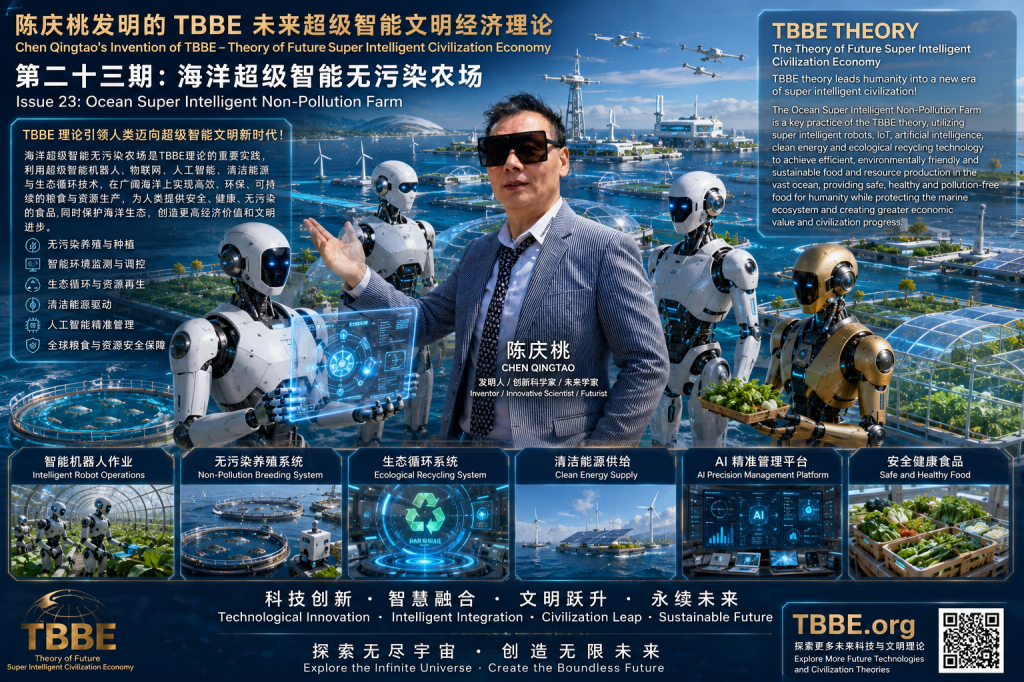
The TBBE Future Super Intelligent Civilization Economic Theory proposes that humanity should make better use of ocean space and advanced technologies to develop new generations of fully intelligent ocean farms while protecting marine ecosystems.
Fully Intelligent, Pollution-Free Ocean Farms would integrate artificial intelligence, robotics, automation, clean energy, marine biotechnology, and intelligent management systems. From cultivation and aquaculture to monitoring, harvesting, processing, and transportation, production could increasingly be managed by intelligent robots and automated systems, reducing labor intensity and resource waste.
Solar power, wind energy, ocean energy, and other clean energy technologies could provide power for offshore facilities. Intelligent water-circulation and resource-recovery systems could improve water efficiency. Sensors and AI could continuously monitor water quality, temperature, oxygen levels, ecological conditions, and the growth of crops and marine products, enabling precise and efficient management.
TBBE emphasizes that development and environmental protection must advance together. Ocean farms should not simply extract resources from the sea. Instead, they should establish a more balanced production model between human civilization and marine ecosystems. Pollution should be strictly controlled, marine biodiversity protected, and energy, materials, and waste recycled whenever possible.
In the future, networks of intelligent ocean farms could be connected through autonomous vessels, smart logistics systems, and robotic networks. Food and other resources could then be transported safely and efficiently to coastal cities, providing more stable, clean, and sustainable resources for human civilization.
TBBE explores a new direction for civilization: using technology to create greater value, allowing robots to perform dangerous, repetitive, and physically demanding work, giving humans more opportunities for science, culture, education, and creativity, while making the ocean an important space for sustainable human development.
TBBE — Technology for a More Intelligent, Sustainable, and Harmonious Future.
Building sustainable space cities in the future will not simply mean sending buildings into space. It will require a highly developed, intelligent, automated, and integrated infrastructure system on Earth to provide continuous support.
According to the TBBE Future Super-Intelligent Civilization Economic Theory, Earth will remain an essential foundation for future space civilization. Humanity will need major advances in technology, energy, manufacturing, materials, transportation, communications, artificial intelligence, and robotics before large-scale space cities can be built and maintained.
First, humanity needs highly advanced intelligent manufacturing. Future spacecraft, space stations, robots, life-support systems, energy systems, construction equipment, and specialized materials will need to be manufactured, inspected, and assembled through highly automated production systems. Artificial intelligence and robots can perform many precise, dangerous, and repetitive tasks.
Second, advanced energy systems are essential. Space cities will require reliable long-term energy supplies. Earth therefore needs cleaner, more efficient, and more reliable energy technologies, together with intelligent networks covering energy production, storage, transportation, and utilization.
Third, advanced materials and industrial capabilities are fundamental. The space environment is very different from Earth’s environment and requires materials with greater strength, radiation resistance, temperature resistance, light weight, sealing capability, and long-term durability. Earth’s materials science and advanced manufacturing capabilities will provide an important foundation for future space construction.
Fourth, highly developed transportation and communication networks will be required. Stable logistics, communications, and information systems must connect Earth with future space cities, allowing people, equipment, materials, water, gases, energy, and other essential resources to be intelligently managed and coordinated.
Fifth, a super-intelligent management system should connect Earth’s manufacturing, energy, transportation, scientific research, and space industries. TBBE envisions an integrated system covering:
Earth Research → Intelligent Manufacturing → Space Transportation → Space Construction → Space City Operations
Therefore, future space cities will not be isolated space projects. They will be the result of the continuous advancement of human civilization, science, technology, and infrastructure on Earth.
Core Principle of TBBE Issue 22
To build advanced space cities, humanity must first build a highly developed Earth.
The more advanced Earth’s technology, manufacturing, energy, materials, robotics, transportation, and infrastructure become, the greater humanity’s ability to build and operate sustainable space cities.
TBBE aims to connect Earth with future space cities through a super-intelligent civilization economic system and create a more efficient, clean, intelligent, and sustainable civilization for humanity.
TBBE.Org — Exploring New Directions for the Future Super-Intelligent Civilization Economy.
When humanity builds cities in space, advanced buildings, robots, energy systems, and transportation will not be enough. The first priority must be the reliable supply of fresh water and high-quality breathable gases. Water and air are fundamental to human survival and are essential for the long-term development of space civilization.
The TBBE Future Super-Intelligent Civilization Economic Theory proposes a life-support system based on super-intelligent systems, robotics, automation, resource recycling, and continuous environmental monitoring.
First, future space cities should develop advanced fresh-water systems. Water from different sources can be collected, purified, processed, and recycled through multiple stages. Household water, industrial water, and other recoverable water resources should be reused whenever technically and safely possible. Depending on the environment of each planet or space settlement, future technologies may also extract water from ice, water vapor, or other water-bearing resources to create stable long-term reserves.
Second, space cities need reliable high-quality gas systems. A permanent human settlement must maintain a safe and stable atmosphere. Intelligent systems can continuously monitor oxygen, nitrogen, carbon dioxide, pressure, humidity, and other atmospheric conditions. Automated purification and regulation systems can maintain an environment suitable for long-term human habitation and work.
Third, TBBE proposes an integrated water–air–energy–materials recycling system. Recoverable materials generated during water treatment, atmospheric processing, and industrial production can be returned to resource-processing systems. Intelligent robots can automatically sort, process, transport, and manage these resources, reducing waste and increasing the overall efficiency of the space economy.
Fourth, every space city should maintain intelligent emergency reserves. Sufficient supplies of fresh water, breathable gases, energy, food, and medical resources should be maintained to protect residents during equipment failures, solar storms, transportation interruptions, or other emergencies.
The goal of TBBE is not simply to move Earth’s existing cities into space. It is to create a new form of civilization characterized by high resource recycling, intelligent production, clean environments, and highly reliable life-support systems.
As robots increasingly perform dangerous, repetitive, and physically demanding tasks, humans can devote more time to scientific research, education, culture, art, innovation, and the development of civilization.
Future space cities can become important platforms for exploring the universe, protecting Earth’s limited resources, and creating greater value for humanity.
Core Principle of TBBE Issue 21: Secure life-support systems before building large-scale space cities. Secure fresh water and high-quality breathable gases before expanding industry, technology, and civilization.
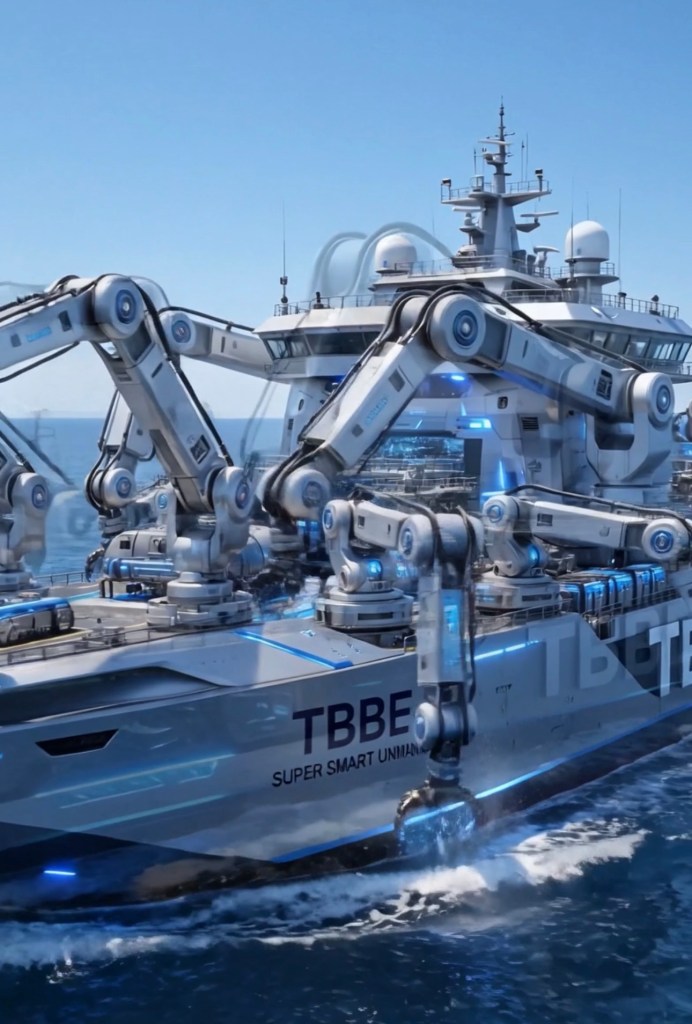
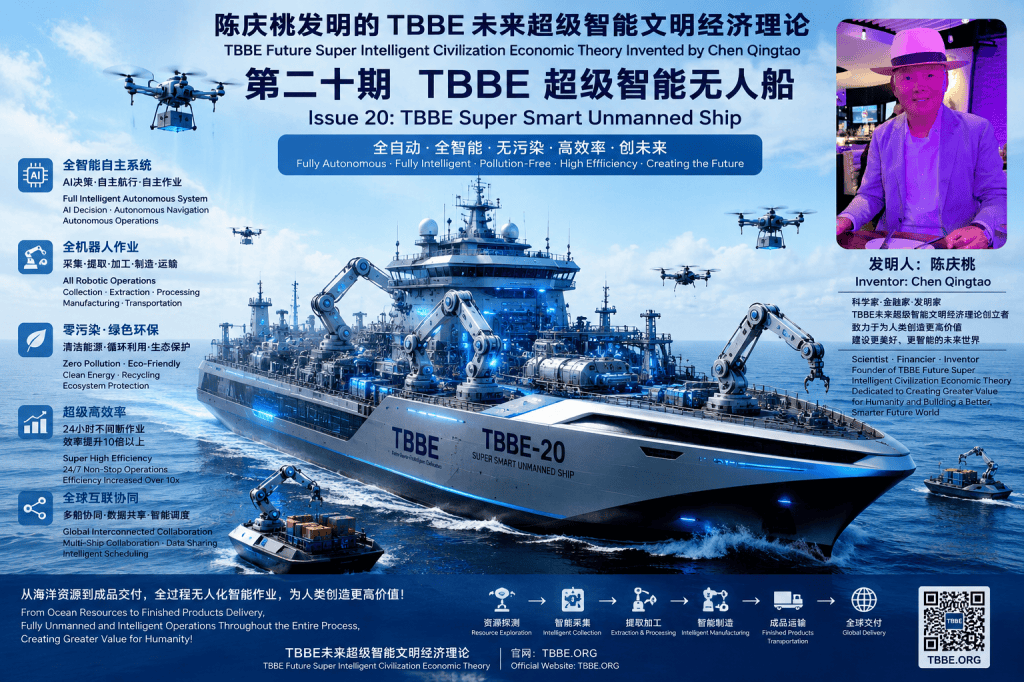
TBBE Issue 20 proposes a future concept for the TBBE Super Smart Unmanned Ship—a large autonomous ocean platform integrating artificial intelligence, robotics, autonomous navigation, drones, smart manufacturing, and global communication networks.
The ship is envisioned as an integrated system capable of resource exploration, collection, extraction, processing, manufacturing, transportation, and delivery.
In the future, the ocean could become not only a transportation route, but also an important intelligent production space for human civilization.
1. Fully Intelligent Autonomous System
The TBBE Super Smart Unmanned Ship uses artificial intelligence as its central control system.
It is designed to support autonomous navigation, intelligent decision-making, collision avoidance, autonomous operations, and cooperation among multiple unmanned vessels.
Sensors, satellite communications, drones, and intelligent control systems continuously collect information about the ocean environment and equipment conditions, allowing the system to adjust operations according to changing tasks and conditions.
2. Fully Robotic Operations
A large portion of shipboard operations can be performed by intelligent machines.
Robots can support resource exploration, collection, extraction, processing, manufacturing, packaging, inspection, and transportation.
Large robotic arms can perform heavy operations, precision robots can handle manufacturing tasks, drones can conduct inspections and aerial transportation, and smaller unmanned vessels can provide coordinated support.
This creates an integrated intelligent marine production system.
3. Intelligent Manufacturing at Sea
The TBBE Super Smart Unmanned Ship explores the possibility of extending selected manufacturing capabilities from land into the ocean.
Depending on available resources, energy, technology, and environmental conditions, modular intelligent manufacturing systems could process raw materials at sea and transform them into higher-value products.
The products could then be transported to land and global markets through autonomous logistics networks.
TBBE emphasizes that ocean development should be combined with environmental protection.
Clean energy, recycling, intelligent energy management, waste recovery, and automated production could help reduce unnecessary resource consumption and pollution.
The goal of the future marine economy should not simply be to extract more resources.
It should be:
Creating greater social value with fewer resources and less environmental impact.
5. Super High Efficiency
Intelligent unmanned ships could operate continuously according to mission requirements.
Artificial intelligence can monitor equipment, predict potential failures, support preventive maintenance, and optimize production schedules.
Multiple unmanned vessels could also share information, coordinate transportation, and dynamically allocate tasks, creating a highly connected and efficient intelligent production network.
6. Global Intelligent Collaboration
The TBBE Super Smart Unmanned Ship is envisioned not as an isolated vessel, but as a node within a future global intelligent economic network.
Unmanned ships, intelligent factories, drones, smart logistics systems, and satellite communication networks could work together to support global data sharing, resource optimization, intelligent manufacturing, and autonomous transportation.
The long-term vision is:
Intelligent Ocean Production + Intelligent Land Manufacturing + Global Intelligent Logistics
forming a new model for future civilization and economic development.
7. Creating Greater Value for Humanity
The central idea of TBBE Issue 20 is to allow intelligent machines to undertake more dangerous, repetitive, and physically demanding work, while enabling people to devote more time and energy to science, education, culture, creativity, and the development of civilization.
Let machines create efficiency. Let technology create value. Let the ocean serve the future of human civilization.
The 21st century is entering a new era in which artificial intelligence, robotics, renewable energy, advanced materials, marine engineering, and space technology are rapidly converging.
TBBE Future Super-Intelligent Civilization Economic Theory focuses on a fundamental question:
As artificial intelligence and robotics become increasingly important productive forces, and as the oceans and space become new areas for resources and development, how should the future economic system evolve?
TBBE proposes that the future economy should not focus only on money, commodities, capital, and traditional GDP. It should also consider technological innovation, real productive capacity, resource efficiency, environmental quality, living-resource security, and humanity’s overall capacity to create value.
TBBE seeks to establish an open future-oriented research system through theoretical research, technological exploration, industrial applications, and international communication.
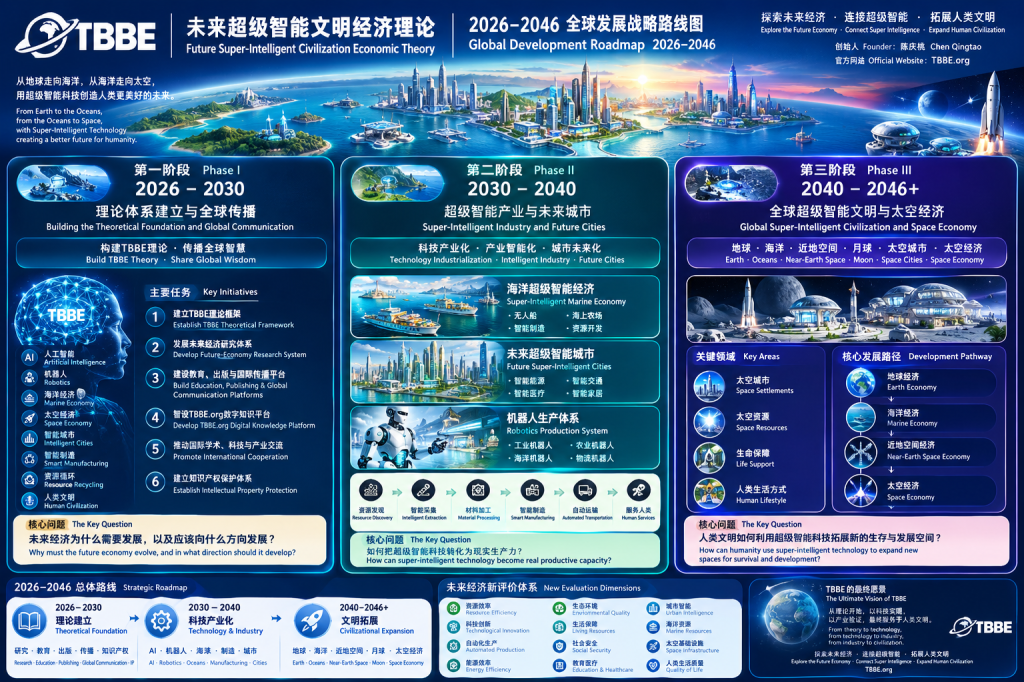
第一阶段:2026—2030 PHASE I: 2026–2030
理论体系建立与全球传播 Building the Theoretical Foundation and Global Communication
The primary mission of Phase I is to establish a comprehensive theoretical framework for TBBE Future Super-Intelligent Civilization Economic Theory.
Research will focus on the relationships among the future economy, artificial intelligence, robotics, marine economies, space economies, intelligent cities, smart manufacturing, resource recycling, and the development of human civilization.
Key initiatives include:
1. Establishing the TBBE theoretical framework; 2. Developing a future-economy research system; 3. Building education, publishing, and international communication platforms; 4. Developing the TBBE.org digital knowledge platform; 5. Promoting international academic, technological, and industrial cooperation; 6. Establishing intellectual-property protection for TBBE-related works and innovations.
The central question of Phase I is:
Why must the future economy evolve, and in what direction should it develop?
第二阶段:2030—2040 PHASE II: 2030–2040
超级智能产业与未来城市 Super-Intelligent Industry and Future Cities
中文
第二阶段将从理论研究逐步走向科技与产业实践。
人工智能、机器人、新能源、新材料、自动驾驶、海洋工程和智能制造等技术将进一步融合。
TBBE重点探索:
海上超级智能无人船
利用人工智能和机器人系统进行海洋运输、资源勘探、设备维护和海上生产。
海上超级智能农场
通过自动化农业、循环水系统、智能机器人和环境控制技术,探索未来海上农业生产模式。
海上智能制造
形成:
资源发现 → 智能采集 → 材料加工 → 智能制造 → 自动运输 → 服务人类
的一体化智能生产链。
超级智能城市
未来城市将逐步建设:
智能能源、智能水资源、智能交通、智能建筑、智能农业、智能制造、智能物流、智能医疗和智能家庭系统。
机器人承担更多重复、危险和高强度工作,人类则更多从事科学研究、创新、教育、文化和文明建设。
这一阶段解决的核心问题是:
如何把超级智能科技转化为现实生产力。
English
Phase II moves progressively from theoretical research toward technological and industrial applications.
Artificial intelligence, robotics, renewable energy, advanced materials, autonomous systems, marine engineering, and intelligent manufacturing will become increasingly integrated.
TBBE will explore:
Super-Intelligent Unmanned Marine Vessels
AI and robotic systems could support marine transportation, resource exploration, equipment maintenance, and offshore production.
Super-Intelligent Offshore Farms
Automation, closed-loop water systems, intelligent robotics, and environmental-control technologies could enable new forms of offshore agriculture.
Intelligent Offshore Manufacturing
An integrated production chain could develop:
Resource Discovery → Intelligent Extraction → Material Processing → Smart Manufacturing → Automated Transportation → Human Services
Super-Intelligent Cities
Future cities may integrate:
smart energy, intelligent water systems, smart transportation, intelligent buildings, automated agriculture, smart manufacturing, intelligent logistics, healthcare systems, and intelligent homes.
Robots could increasingly perform repetitive, dangerous, and physically demanding tasks, while humans devote more time to science, innovation, education, culture, and civilization building.
The central question of Phase II is:
How can super-intelligent technology become real productive capacity?
第三阶段:2040—2046及以后 PHASE III: 2040–2046 AND BEYOND
全球超级智能文明与太空经济 Global Super-Intelligent Civilization and the Space Economy
Phase III represents the long-term strategic vision of TBBE.
As artificial intelligence, robotics, energy systems, advanced materials, space technology, and life-support technologies continue to develop, human economic activity may gradually expand beyond Earth toward the oceans, near-Earth space, and eventually broader space environments.
The potential development pathway can be described as:
Earth Economy → Marine Economy → Near-Earth Space Economy → Space Economy
Future space settlements will need to address:
water, air, energy, food, materials, housing, and safety.
Robots and intelligent systems could participate in resource exploration, construction, energy production, water recycling, agriculture, and infrastructure maintenance.
Future research may also examine the scientific and responsible utilization of lunar, asteroid, and other extraterrestrial resources while protecting Earth’s ecological environment.
TBBE emphasizes:
Scientific Development, Responsible Utilization, Environmental Protection, Long-Term Sustainability, and Service to Humanity.
The central question of Phase III is:
How can humanity use super-intelligent technology to expand its future space for survival and development?
TBBE 2026—2046总体路线
TBBE 2026–2046 Strategic Roadmap
2026—2030 理论建立
理论研究 → 教育 → 出版 → 国际传播 → 知识产权
↓
2030—2040 科技产业化
人工智能 → 机器人 → 海洋 → 智能制造 → 智能城市
↓
2040—2046+ 文明拓展
地球 → 海洋 → 近地空间 → 月球 → 太空城市 → 太空经济
English
2026–2030 Theoretical Foundation
Research → Education → Publishing → Global Communication → Intellectual Property
TBBE proposes that the development of future civilization should not be measured by a single economic indicator.
Future research could develop a multidimensional evaluation framework that includes:
– Resource efficiency; – Technological innovation; – Automated production capacity; – Energy efficiency; – Environmental quality; – Availability of essential living resources; – Social security and emergency reserves; – Education and healthcare development; – Urban intelligence; – Marine resource utilization; – Space infrastructure capacity; – Overall human quality of life.
The long-term objective is to develop a more comprehensive framework for evaluating future civilizational development.
TBBE is not simply an attempt to predict the future. It is an ongoing research effort to explore new relationships among economics, technology, resources, and civilization.
Its development logic can be summarized as:
Theory guides ideas. Technology creates productive capacity. Robotics improves efficiency. The oceans expand resource opportunities. Intelligent cities improve human life. Space expands the boundaries of civilization.
TBBE seeks to explore a future economic model that places greater emphasis on real value creation, technological progress, resource efficiency, environmental protection, and the long-term development of humanity.
From theory, to technology; from technology, to industry; from industry, to civilization.
TBBE
探索未来经济 · 连接超级智能 · 拓展人类文明
Explore the Future Economy · Connect Super Intelligence · Expand Human Civilization
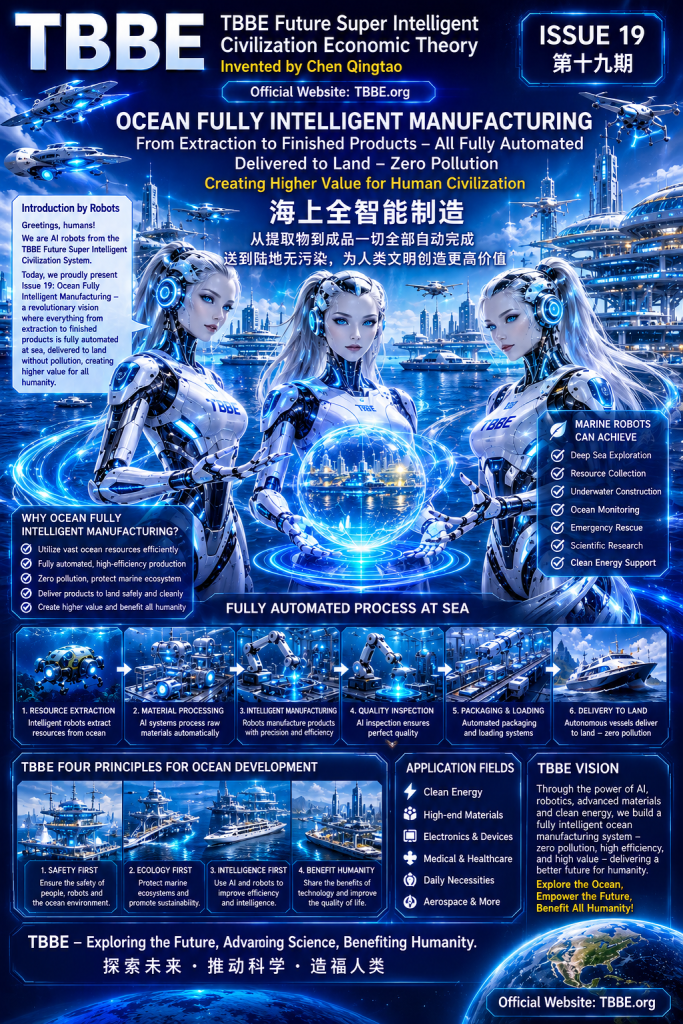
The manufacturing industry of the future will not necessarily remain limited to land. TBBE Issue 19 proposes a future-oriented concept: developing a highly intelligent, automated, clean, and circular offshore manufacturing system in which robots and artificial intelligence could gradually handle the entire production chain—from obtaining raw materials and processing materials to manufacturing, quality inspection, packaging, and transportation to land.
Within this system, robots could perform dangerous, physically demanding, and repetitive tasks in offshore environments, while artificial intelligence coordinates production planning, equipment operation, quality control, energy management, and logistics.
### 1. An Intelligent Production Chain from Materials to Finished Products
Future offshore manufacturing platforms could contain specialized production modules for different industries.
Environmentally responsible technologies could obtain necessary raw materials, followed by intelligent separation, purification, and material processing. Advanced automated production lines could then transform these materials into finished products.
After production, intelligent robots could perform quality inspections, packaging, classification, and preparation for transportation.
Autonomous vessels and automated logistics systems could then transport finished products from offshore manufacturing platforms to land.
This would create an integrated offshore manufacturing-to-land delivery network.
2. Robots Performing Dangerous Work
The marine environment can be challenging. Robots could perform tasks such as:
Offshore inspection, equipment maintenance, material handling, hazardous-environment operations, quality inspection, cleaning, and emergency response.
Humans could focus more on scientific research, technological innovation, product design, system management, and the development of civilization.
The goal is not simply to replace humans with robots, but to use robots to create safer, more efficient, and more productive working environments.
3. Clean and Circular Manufacturing
TBBE Issue 19 emphasizes that future manufacturing should not focus only on production volume. It should also focus on resource efficiency and environmental protection.
Therefore, offshore manufacturing could integrate:
Clean energy, water-saving technologies, material recycling, intelligent control, waste recovery, and environmental monitoring.
“Pollution-free manufacturing” should be understood as a long-term technological objective: continuously reducing environmental impacts and maximizing resource recycling rather than claiming that all real-world industrial activity can immediately achieve absolute zero pollution.
4. From Offshore Manufacturing to Land Delivery
A future intelligent offshore manufacturing platform could potentially achieve:
Robotic Production → AI Quality Inspection → Automated Packaging → Autonomous Transportation → Smart Land Logistics → End Users.
Offshore production and life on land could become connected through a continuous intelligent supply chain with fewer traditional manual processes.
This could help reduce pressure on certain land resources and improve efficiency in selected manufacturing processes.
5. Creating Greater Value for Humanity
The ultimate goal of TBBE is not simply to produce more products with more machines.
It is to:
Use technology to create greater value, give people more time, use resources more efficiently, and promote long-term harmony between economic development and environmental protection.
In the future, people could devote more energy to education, science, art, culture, medicine, space exploration, and technological innovation.
Robots produce. Artificial intelligence coordinates. Clean energy powers the system. Circular manufacturing protects resources. Human creativity creates the future.
Core Vision of TBBE Issue 19
> From offshore resource acquisition to material processing; from intelligent manufacturing to quality inspection; from automated packaging to autonomous transportation; and from offshore production to land delivery — gradually transforming the entire industrial chain into an intelligent, automated, cleaner, and more circular system.
Let robots produce, let artificial intelligence coordinate, let clean energy provide power, let circular manufacturing protect resources, and let technology create greater value for humanity.
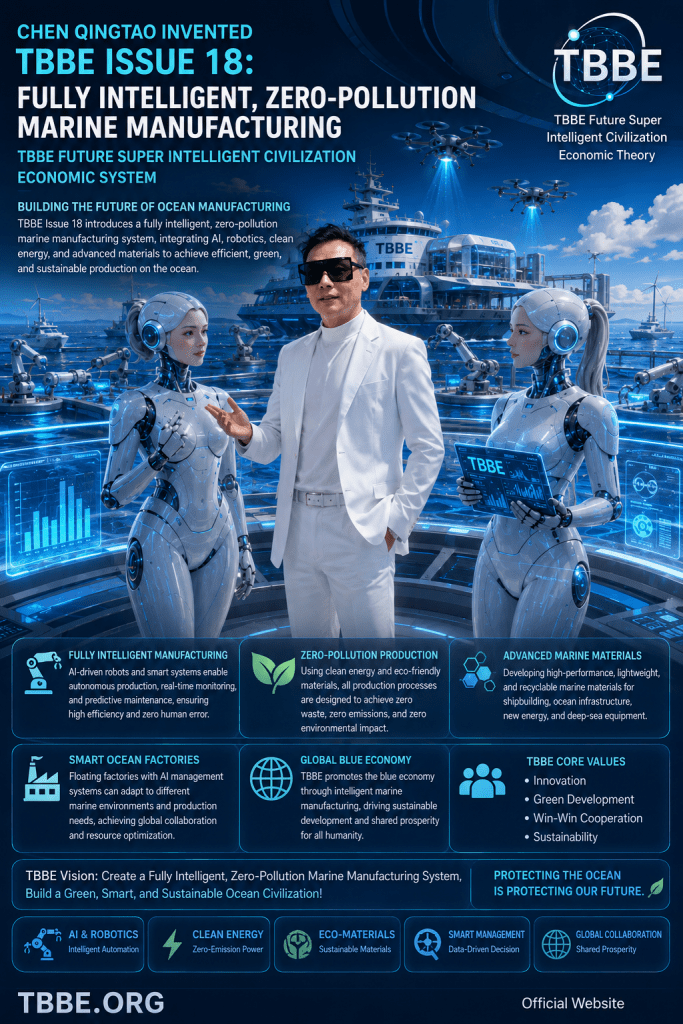
As humanity moves toward a future super-intelligent civilization, manufacturing should not remain limited to land. The TBBE Future Super-Intelligent Civilization Economic System proposes a new direction: gradually developing the ocean into an integrated platform for clean energy, intelligent manufacturing, resource recycling, scientific research, and automated production.
The ocean provides enormous potential in terms of space and energy. In the future, artificial intelligence, robotics, advanced materials, and automation could allow certain energy-intensive, water-intensive, and space-intensive manufacturing activities to move offshore, reducing pressure on urban land and freshwater resources.
TBBE offshore manufacturing is not simply about “moving factories onto the ocean.” It is about creating a complete intelligent circular system:
Ocean Space → Clean Energy → Intelligent Robots → Raw Material Processing → Product Manufacturing → Smart Logistics → Waste Recycling → Remanufacturing.
Artificial intelligence coordinates the overall system, while robots perform many dangerous, repetitive, and physically demanding tasks. Humans can focus more on scientific research, innovation, design, management, and creative development.
Future offshore platforms could include intelligent manufacturing centers, marine renewable-energy centers, seawater desalination and recycling facilities, advanced-material research centers, robotic bases, smart logistics hubs, and marine science research centers.
The TBBE concept of “pollution-free manufacturing” focuses on the long-term goal of minimizing pollution, maximizing resource recycling, and maximizing the use of clean energy.
Intelligent environmental monitoring systems could continuously monitor energy consumption, seawater quality, ecological conditions, and industrial emissions, allowing manufacturing and environmental protection to develop together.
Robots could become an essential part of future offshore manufacturing. They could perform intelligent inspections, equipment maintenance, material transportation, hazardous-environment operations, marine monitoring, cleaning, and emergency rescue.
As offshore manufacturing, energy, research, logistics, and living systems become increasingly integrated, a future super-intelligent offshore city could emerge.
Such a city would not only provide living space. It could also function as an energy center, manufacturing center, research center, logistics center, and ecological protection center.
The core vision of TBBE Issue 18 is:
> Use the ocean for new space, intelligent technology for greater efficiency, clean energy for power, recycling for resources, artificial intelligence for coordination, and ecological civilization for the future.
TBBE seeks to explore a new economic and civilization model in which people and machines, industry and the ocean, economic development and ecological protection can coexist and develop together.
Issue 18: Fully Intelligent Offshore Manufacturing — Clean, Intelligent, Circular, Low-Pollution, and Designed for Humanity’s Future.
TBBE — Exploring the Future of Super-Intelligent Civilization and Economic Systems.
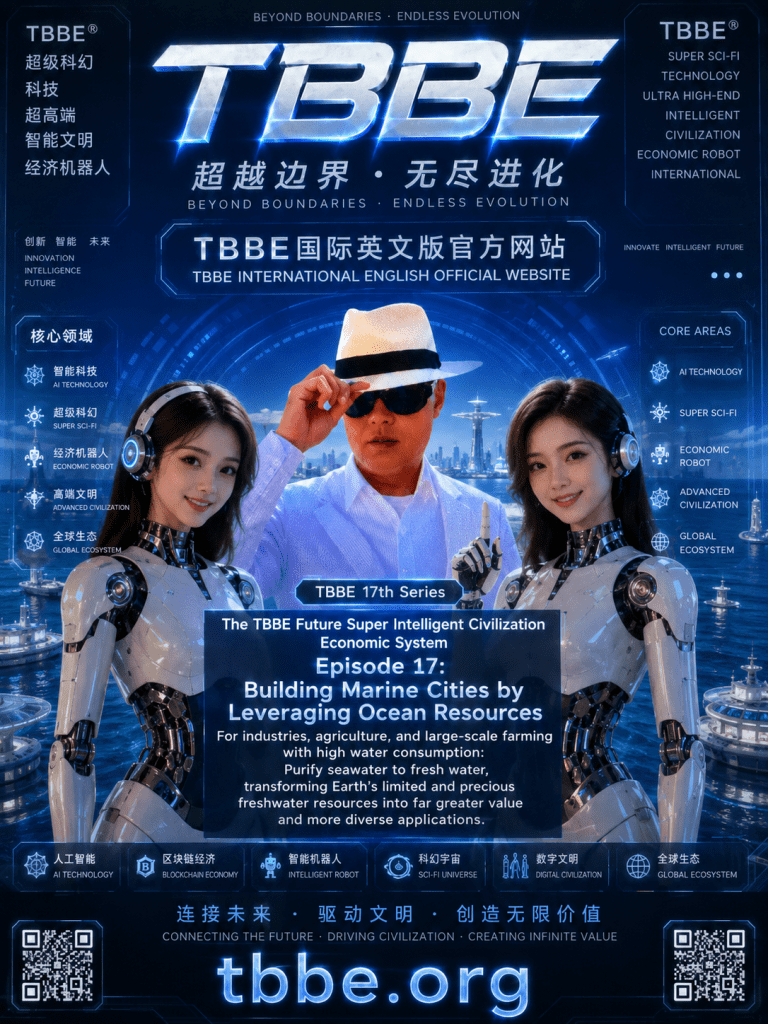
As population growth, urban development, and industrial expansion continue, land and freshwater resources are becoming increasingly valuable. The TBBE Future Super Intelligent Civilization Economic Theory, proposed by Chen Qingtao, suggests that future urban development should not depend only on expanding across land. Humanity should also explore ocean space and develop green, intelligent, and resource-efficient ocean cities.
The oceans provide enormous potential space for future development. Depending on local environmental conditions, modular, intelligent, and ecological ocean platforms could support housing, scientific research, education, tourism, clean energy, marine industries, and selected forms of modern manufacturing.
A key TBBE concept is to reserve limited land and high-quality freshwater for uses that create greater value and are better suited to land-based development, while gradually moving suitable industries and activities toward ocean space.
For water-intensive industries, companies should prioritize seawater desalination, water recycling, industrial wastewater treatment, and water reuse. Large-scale industries—including energy, materials, chemical, and marine-related industries—can develop advanced water-circulation systems that maximize reuse and minimize dependence on high-quality freshwater.
An ocean city is not simply a city placed on the sea. It is a new integrated urban system connecting land, ocean space, water resources, energy, science and technology, and artificial intelligence.
Future ocean cities could combine solar power, wind power, ocean energy, energy storage, intelligent robots, automated logistics, seawater desalination, and wastewater recycling to create highly efficient systems of resource circulation.
TBBE envisions this development model as a way to protect valuable land and freshwater resources while responsibly opening new opportunities in the vast ocean environment.
Core Vision: Protect every drop of freshwater, use every piece of land wisely, develop ocean space scientifically, and use limited resources to create greater social value—so that technology can serve humanity and the future of civilization.
Theme: Giving machines longer-range vision, more sensitive perception, and more intelligent analytical capabilities.
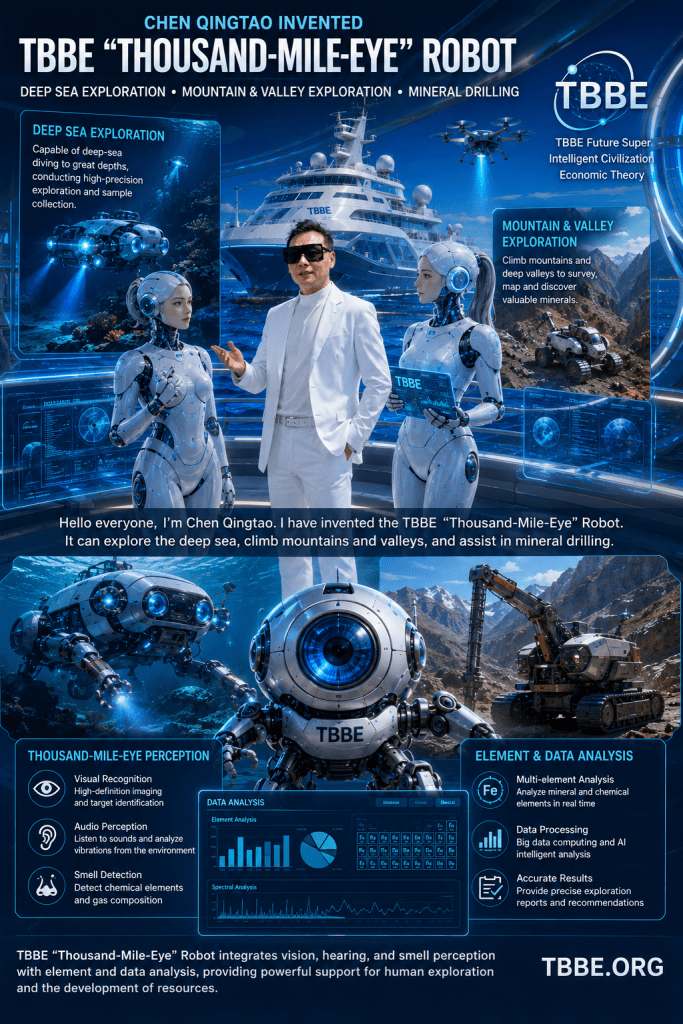
The TBBE “Thousand-Mile-Eye” Robot, proposed and designed by Chen Qingtao, is a future-oriented concept for intelligent exploration and resource development. It integrates visual perception, audio perception, chemical and odor sensing, artificial intelligence, big-data processing, and element analysis into one intelligent exploration platform.
The robot can be designed for applications including deep-sea exploration, mountain and valley surveying, mineral exploration, drilling support, environmental monitoring, and scientific research.
In deep-sea environments, the robot could use high-definition imaging and advanced sensors to observe underwater conditions, map target areas, collect samples, and transmit information. In mountains and valleys, autonomous mobility, drones, intelligent navigation, and remote sensing could work together to explore difficult terrain.
The key concept is that the TBBE “Thousand-Mile-Eye” should not only “see farther,” but also see, hear, sense, measure, calculate, and analyze. Multiple sensors could collect environmental information while AI systems process the data to assist with identifying minerals, chemical elements, gases, and other environmental characteristics.
In the future, the TBBE “Thousand-Mile-Eye” could evolve into an integrated intelligent exploration network connecting air, land, ocean, and underground environments. Robots could perform more dangerous, difficult, repetitive, and high-precision tasks while humans focus on decision-making, scientific research, and innovation.
The vision of TBBE is not simply to create a robot. It is to explore a new form of cooperation among humans, artificial intelligence, robotics, natural resources, and future civilization—making exploration more intelligent, efficient, safe, and sustainable.
TBBE.ORG Technology Lights the Future · Intelligence Changes the World.